

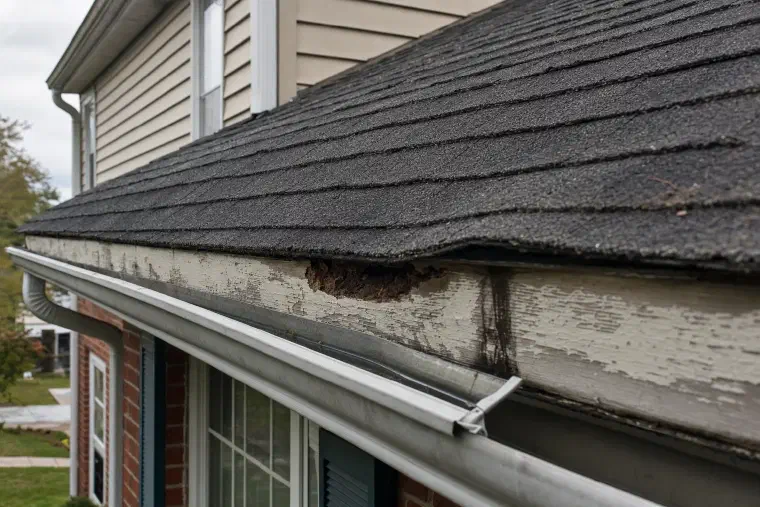
A fascia board is the long board that runs along the bottom edge of your roof, and it rots because the gutter fixed to it lets water sit against the wood or run down behind it. Wood stays sound while it stays dry. Keep it wet for long enough and it goes soft, dark and crumbly.
The short version
- The fascia is the finished face of your roof edge. It is also what your gutters are screwed to.
- It rots when water is held against it, most often by a clogged gutter or water running behind one.
- Peeling paint, a sagging gutter and soft, dark wood are the signs you can spot from the ground.
- The rot does not stop at the board. It can carry on into the rafter ends and the first few inches of the roof deck.
- Fixing the water problem matters more than swapping the board.
What is a fascia board?
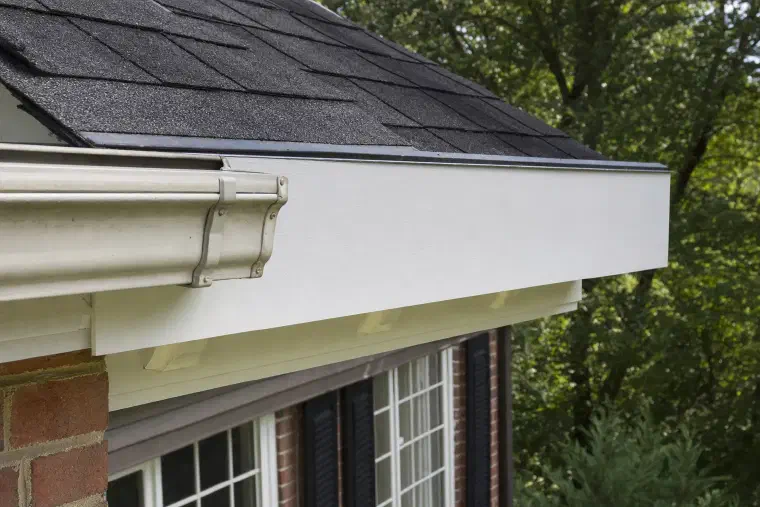
A fascia board is the straight, flat board fixed to the ends of the rafters along the edge of the roof. This Old House describes it as the finished appearance (opens in a new tab) of your roof’s edge, and the solid surface that gutters and trim attach to.
Most people never think about it until it fails, because it sits right at the eave, where the roof ends and the gutter starts. The soffit is the panel underneath it, on the underside of the overhang. The two get mixed up all the time, and both are made of the same thing: wood that has to stay dry.
Why does a fascia board rot?
A fascia board rots when its wood stays wet for long stretches, because rot is a living thing that needs water. Penn State Extension explains that wood-decay fungus needs water in the wood (opens in a new tab), and that one of the best ways to prevent fungal decay is to dry the wood and keep it dry.
A fascia gets plenty of chances to stay wet. It sits at the exact point where the whole roof drains. Rain runs off the shingles, over the edge and into the gutter, so the board has water passing within inches of it every storm. Paint keeps that water out for a while. Once the paint cracks and peels, the raw wood soaks it up like a sponge.
Then comes the annoying part. Wet wood dries slowly when it is boxed in behind a gutter, with no sun and no breeze, so the same spot stays damp for weeks.
How does water get to the fascia?
Water reaches the fascia in four main ways, and a gutter is involved in every one of them:
| How it happens | What the water does |
|---|---|
| The gutter is full of leaves and needles | Water backs up, sits in the trough and soaks the board it is fixed to |
| Water runs off the shingles and curls back behind the gutter | It runs down the back of the board, where nobody can see it |
| The gutter has pulled away or sags | The gap lets water past the trough and onto the wood |
| The metal edge strip under the shingles is missing or wrong | Water is trapped behind the fascia board |
That last one is worth a closer look. The gutter and the roof edge have to work as one path. Without a drip edge (opens in a new tab) done right, This Old House says water can seep into rot-prone parts such as the roof deck and fascia boards. Water likes to cling to a surface rather than fall off it, so it follows the edge of the roof back toward the wood.
The second row of that table is one we know well. Water wicking behind a gutter that has no gutter apron, which is the metal strip that bridges the roof edge and the back of the gutter, rots the fascia first.
What does a rotting fascia board look like?
A rotting fascia board looks like peeling paint, dark streaks and wood that gives when you press it. You can check most of it from the ground with a pair of binoculars, or from a ladder if you are comfortable on one:
- Paint that bubbles, flakes or peels along the bottom edge of the board.
- Dark stains or green growth on the board, especially behind the gutter.
- A gutter that sags, pulls away or has nails working loose.
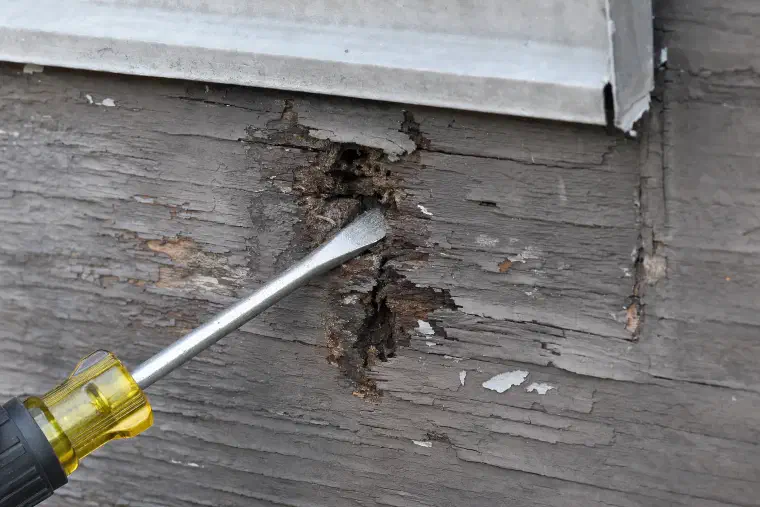
- Wood that feels spongy, or a screwdriver that sinks in with light pressure.
- Water dripping behind the gutter rather than into it during a storm.
How far does the rot go?
The rot usually goes further than the board you can see. Standing water in a full gutter, or water wicking behind a gutter with no apron, rots the fascia first, then the ends of the rafters, then the first few inches of roof decking. The rafter ends are the wooden beams the fascia is fixed to, and the decking is the plywood under your shingles.
This is a real structural repair at the eave, and it is invisible from both the attic and the ground. A full gutter also gives an ice dam something to build on in winter, which adds more water to the same spot.
This Old House makes the same point in its guide to fixing roof edge damage: visible damage (opens in a new tab) is often only part of the problem, and water intrusion at the roof edge often affects several parts at once. That is why we check past the obvious spot before we say what a fix involves.
Can you replace just the rotted part of a fascia board?
Sometimes you can, if the rot is in one short section and the wood behind it is sound. A short run of bad board can be cut out and replaced, and the new wood sealed and painted.
It is a poor trade if the water is still getting in. New wood behind the same clogged or pulled-away gutter will rot the same way. So the order matters: find out where the water is coming from, fix that, then replace the wood.
Our gutter work covers gutter repair, including resealing, re-pitching and fascia. Keep in mind that rotted wood is not part of a standard roof replacement. Fascia, soffit and trim carpentry is priced as time and materials, or left out, so it pays to ask about it before the job starts.
How do you stop a fascia board from rotting?
You stop a fascia board from rotting by keeping water off it, and most of that is upkeep. It comes down to a short list:
- Keep the gutters clear. Under the big trees around Ellicott City they fill up fast. Our gutter cleaning covers the troughs and downspouts.
- Fix a sagging or loose gutter as soon as you see it, before water finds the gap.
- Repaint or reseal the board when the paint starts to fail.
- Make sure water leaves the roof edge and lands inside the gutter, not behind it.
Have the roof edge looked at at the same time. Our free roof inspection covers the roof surface, the flashing, the valleys and the gutters.
Common questions
How long does a fascia board last?
This Old House puts wooden fascia at up to 15 years (opens in a new tab), vinyl at up to 20 and aluminum at more than 20. How dry it stays matters as much as what it’s made of: a board behind a gutter that overflows every storm won’t reach those numbers.
Is a rotted fascia board an emergency?
Not usually, but it is not one to leave for later. Damaged wood holds water, so a soft spot tends to get worse, not better. If you find a soft spot, get it looked at this season. If water is coming in past the eave or the ceiling near the outside wall is stained, call us.
Can I paint over a soft fascia board?
No. Paint on rotted wood hides the problem and does not stop it. Fungus keeps working under the paint while the wood stays damp. Cut out or replace the soft wood, fix the water problem and then paint.
Can a clogged gutter rot a roof?
Yes, and slowly enough that you may not notice. The water sits against the board, then the rafter ends, then the edge of the decking. It is one of the most common reasons we see a small gutter problem turn into carpentry at the eave.
What to do next
If you have peeling paint, a sagging gutter or a soft spot on the board, the sooner someone looks, the smaller the fix tends to be. Call us any time, or ask us for a visit and we will check the board, the gutter and the roof edge together.


