

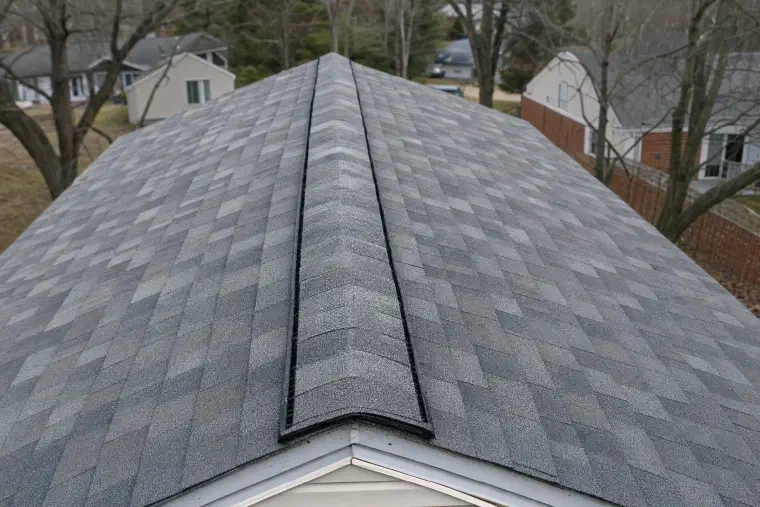
A ridge vent is a long, low vent that runs along the top of your roof, under the ridge-cap shingles. It lets hot, damp air leave the attic. Cooler air comes in through vents under the roof edge, rises as it warms, and exits at the peak. It only works if that air can get in.
The short version
- A ridge vent is an exhaust vent. It lets air out, and it needs intake vents low on the roof to pull air in.
- It sits under the ridge-cap shingles, so from the street it looks like a thicker peak.
- The most common reason one does nothing is blocked soffit vents, not a bad vent.
- Mixing a ridge vent with gable, box or fan vents can make the air loop instead of crossing the attic.
- A new roof from us includes a ridge vent or box vents per the ventilation plan.
How does a ridge vent work?
A ridge vent works because warm air rises and wind pulls on it. A slot is cut along the top of the roof boards on both sides of the peak, and the vent is fastened over that slot. Warm air in the attic drifts up and out through it, and wind blowing across the roof helps pull it along.
Something has to replace that air. Cool outside air enters low, usually through soffit vents, which are vents in the flat panel under the edge of your roof. The Asphalt Roofing Manufacturers Association describes the goal as a balanced-airflow approach (opens in a new tab) that lets air wash the whole underside of the roof deck from low to high.
Why does a roof need a ridge vent?
A roof needs a way to get rid of heat in summer and moisture in winter. Energy Star says that in summer, a well-vented attic moves super-heated air out (opens in a new tab). In winter, the air that leaks up from your living space carries moisture, and that moisture needs somewhere to go before it settles on cold roof boards.
Virginia Tech’s extension service recommends a continuous ridge vent (opens in a new tab) along the peak, paired with continuous soffit vents at the eaves. That is why it is the exhaust we reach for on most shingle roofs. We cover what happens when the air stops moving in why attic ventilation matters.
What does a ridge vent look like from the ground?
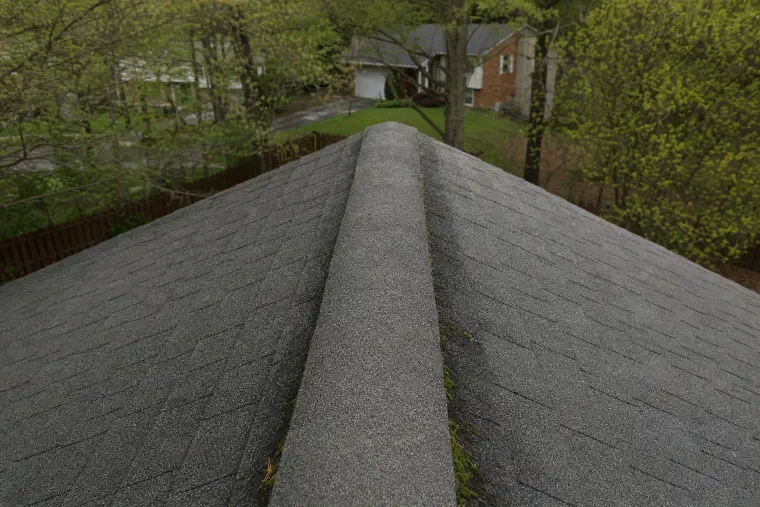
Almost nothing, and that is the idea. The vent is a thin strip, and ridge-cap shingles are laid over the top of it, so it reads as a slightly thick peak. You will not see a hole or a metal cap the way you do with a box vent.
The easiest place to spot one is at the end of a gable roof, where you can see the peak in profile. A plain ridge cap lies flat and tight. One with a vent under it sits a little thicker.
Why does a ridge vent stop working?
The usual reason is that no air can get in at the bottom. A ridge vent can only pull what is offered to it. We see two versions of this all the time: a ridge vent installed with the soffits never cut open, and attic insulation pushed over the soffit vents. Energy Star’s advice is blunt: never cover soffit vents (opens in a new tab) with insulation, and use rafter vents to keep the air path open.
Two other things go wrong:
- Too much exhaust. The Asphalt Roofing Manufacturers Association notes that it is better to have more intake (opens in a new tab) than exhaust, and that a full-length ridge vent can have its slot narrowed to keep things balanced.
- Other vents on the same attic. The same group says that combining different types of exhaust vents (opens in a new tab) above one attic space should be avoided, because one exhaust vent can pull air from another instead of from the intake.
Gable vents are the classic case. The association also warns that gable end vents with a ridge vent and weak soffit intake can pull moisture into the home (opens in a new tab) during a heavy rain or snow.
Where does the ridge vent sit on the roof?
At the top, as close to the peak as the roof allows. The association quotes the building code wording that upper ventilators should be no more than 3 feet below the ridge (opens in a new tab). A ridge vent is right on it, which is why it is such a good fit on a gable or hip roof with a decent run of peak.
On a roof with a short ridge, such as a small hip roof, there may not be enough length to move the air a house needs. That is when box vents on the upper slope are the better answer. We lay the two options side by side in the different types of roof vents.
Ridge vent or box vents: how do they compare?
| Ridge vent | Box vents | |
|---|---|---|
| Where | Along the whole peak | Several spots near the top of a slope |
| Holes in the roof | One long slot, covered by the cap | One hole per vent, each flashed |
| Looks | Hidden under ridge-cap shingles | Small caps you can see from the street |
| Best on | Roofs with a long ridge | Short ridges, small hip roofs |
| Needs | Open soffit intake | Open soffit intake |
What does a ridge vent cost?
On a new roof, a ridge vent or box vents per the ventilation plan are part of what we include. Ventilation upgrades past the code minimum, such as adding a ridge vent where there was none or cutting in soffit intake, are a separate line.
Fixing an existing one typically runs $700 to $1,600 for a ridge vent repair. Re-securing a loose ridge cap typically runs $350 to $700. These are area ranges, not a quote, and the job depends on the roof’s pitch and access.
Common questions
Do I need soffit vents if I have a ridge vent?
Yes. Soffit vents are the intake, and a ridge vent has nothing to pull without them. If the soffits are solid or blocked, the ridge vent may pull air from the house instead.
Can a ridge vent leak?
It can. A loose or damaged ridge cap lets water in, and so can a mix of vents that fights each other. A water stain near the peak is worth having looked at.
How much ridge vent does my attic need?
It depends on the attic size and the vent’s net free area, which is the open space air can move through. Virginia Tech gives a guideline of about 1 square foot of vent opening (opens in a new tab) for every 150 square feet of attic space, though local code can differ. Our walk-through of how to calculate attic ventilation shows the math.
Can insulation block a ridge vent?
Not the vent itself, but it can block the air that feeds it. Insulation pushed into the eaves covers the soffit openings. Baffles are the fix, and we explain them in what attic baffles are.
What to do next
If you are not sure your attic can breathe, or you have a ridge vent that seems to do nothing, have the vents and the roof edge looked at. Our attic venting page explains what we check. We look at the vents from the roof and, when we can get in safely, from the attic.


