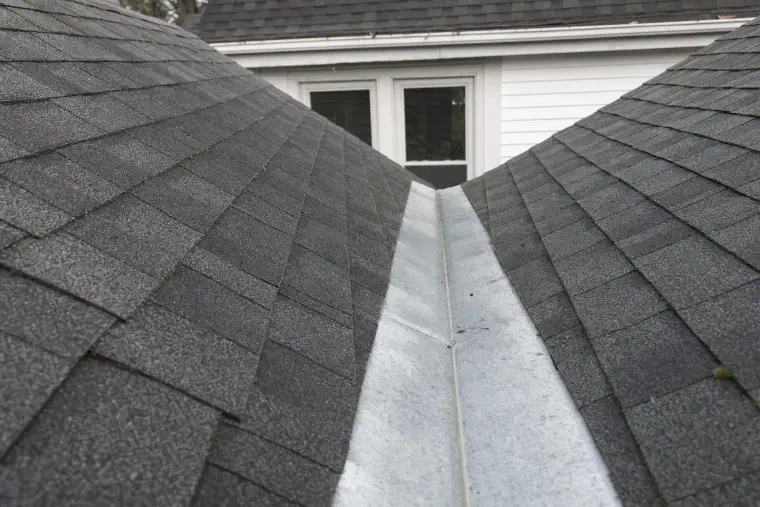
A roof valley is the V-shaped low spot where two slopes of a roof meet. Rain and snowmelt from both slopes run down into it, so it carries more water than any other part of the roof and is one of the places that leaks first.
The short version
- A roof valley is the inside corner where two roof slopes meet, and it works like a gutter that runs down the roof.
- It comes in two styles: open, with a strip of metal showing, and closed, where shingles cover it.
- Valleys leak because so much water funnels through them, and because the metal or sealing layer underneath was skipped or has worn out.
- Leaves and debris packed into a valley make it worse.
- A valley repair typically runs $700 to $1,800, and a repair is often all it needs.
What is a roof valley?
It is the inside corner of the roof. This Old House defines a valley as the internal angle formed by the intersection of two sloping roof planes (opens in a new tab). A ridge sticks up, and a valley dips down.
You’ll find valleys wherever a roof has an L shape, a dormer, an addition or a porch roof meeting the main house. A plain two-slope roof has none. A roof with a lot of corners can have a dozen.
If you want to see how a valley fits in with the rest of the roof, our guide to the parts of a roof covers the other names.
Why do roof valleys leak?
Because everything on two slopes ends up in one narrow channel. The Building America Solution Center says valleys and penetrations are among the most vulnerable areas (opens in a new tab) for water intrusion. A shingle in the middle of a slope sees the rain that lands on it. A valley sees the rain from both slopes.
That much water leaves no room for shortcuts. The usual causes are:
- Valley metal that was never put in. We see this on roofs that were done cheaply, and the shingles alone are left to carry the flow.
- No self-sealing layer underneath. Ice-and-water shield is commonly left out of valleys, even though freeze and thaw cycles in Ellicott City put them under real strain. We cover it in what ice and water shield is.
- Metal that has rusted or lifted. The University of Wisconsin Extension tells homeowners to look for corroded, loose or displaced flashing (opens in a new tab) on sloping roof valleys.
- Caulk or roofing tar over a problem. Tar keeps shingles from bonding, traps moisture and often hides rotted decking underneath. Caulk is a scheduled leak, since it wears out in 5 to 10 years.
- A pile of leaves. More on that below.
What is the difference between an open and a closed valley?
An open valley shows a strip of metal down the middle, and a closed valley hides everything under shingles. In an open valley, the roofer lays a metal liner in the V and trims the shingles back on each side, so the water runs down the metal. In a closed valley, the shingles from one slope run across the V and the other slope’s shingles are trimmed and tucked in.
Closed valleys come in two kinds. In a woven valley, the shingles from both slopes are laid over each other in turn. In a closed-cut valley, one slope’s shingles run through and the other side is cut along a line.
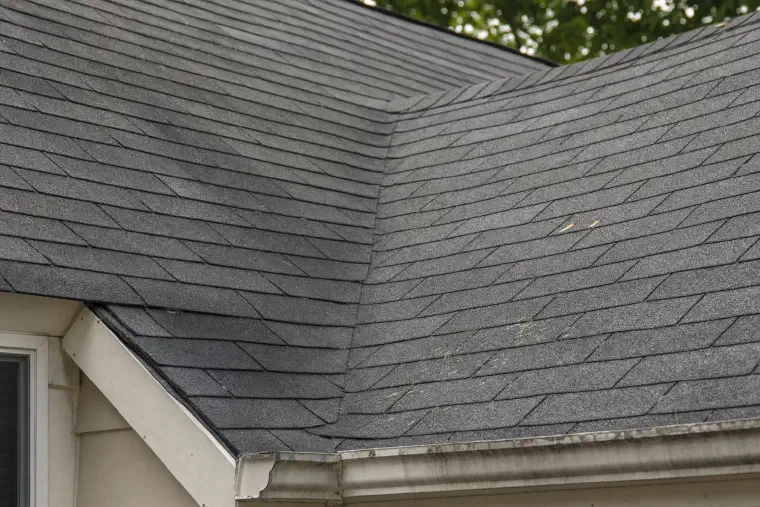
| Open valley | Closed valley | |
|---|---|---|
| What you see | A strip of metal down the V | Shingles only |
| What carries the water | The metal | The overlapping shingles |
| Looks | More visible | Blends in |
| Where it tends to fail | Rusted, lifted or badly lapped metal | Debris sitting on shingle edges, and thick shingles that don’t lie flat |
Which one is better? The Building America Solution Center recommends metal valleys over woven or abutted shingle (opens in a new tab) valleys when you’re putting on a shingle roof. A closed valley can still last for years when it is done well. But metal gives the water a smooth path, and shingle edges give it somewhere to catch.
What does a roof valley leak look like?
Often it looks like nothing for a long time. The annoying part is that a ceiling stain is the last stage, not the first. Water has usually been getting in for years, wetting the decking and the insulation, before anything shows inside.
Signs worth checking:
- a brown stain on a ceiling that follows the line of a roof corner
- shingle granules piled at the bottom of a valley, or bare patches in the channel
- rust streaks or a lifted edge on exposed valley metal
- a thick bead of tar or caulk along the V
- a leak that only shows up in hard rain, which often means a flashing problem that depends on the wind direction
Stand in the yard with binoculars, because you can see a lot of this without going near a ladder. Please don’t walk the roof yourself. Valleys are wet, slippery and exactly where a foot goes through.
Do leaves and debris matter in a valley?
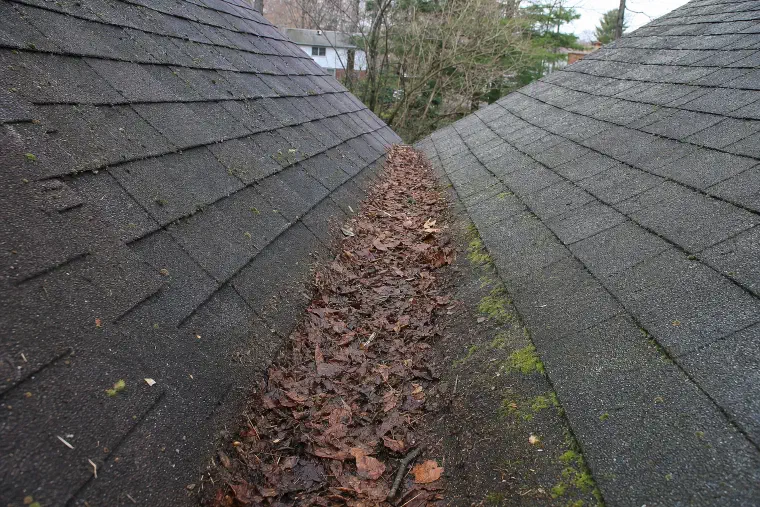
Yes, because a valley that is full can’t carry water away. Leaves, twigs and grit sit in the channel, and rain backs up behind them. In wooded parts of Ellicott City we see this all the time. Debris damming in valleys and gutters pushes water up under the shingles above the ice-and-water line.
This Old House says that during roof inspections (opens in a new tab) you should check valleys for debris and proper sealing. Sometimes clearing the valley is the whole fix. That is billed as a service call, and it’s far cheaper than the repair that follows a year of standing water.
How much does a roof valley repair cost?
A valley repair typically runs $700 to $1,800. That sits in the middle tier of repairs, where most service calls land. The number goes up when the decking underneath is wet or soft, because decking replacement is separate and is added at $150 to $500 or more once the crew finds it.
The repair itself is usually quick. A crew is on site for 1 to 4 hours for most repairs, and the whole thing runs 1 to 2 weeks from call to completion in normal conditions. Weather matters, since repairs need a dry roof.
Two honest limits. A repair covers one location, so other problems we find are a separate estimate. And no one can promise a leak will stop, since leak diagnosis is a matter of probabilities. We tell you what we find before we start.
Does a new roof include new valley metal?
Ours does. A full roof installation from Roofing NextGen Ellicott City includes ice-and-water shield at the eaves, valleys and penetrations, and new flashing at chimneys, walls, valleys, skylights and other penetrations, unless the quote says flashing is being reused. Shingle brand matters less than this. Water gets into a roof at flashing, valleys, penetrations and transitions, and all of those are labor details.
When you compare bids, ask what goes in the valleys, and ask to see it in writing.
Common questions
Can I fix a leaking roof valley myself?
You can clear leaves from a valley with a soft brush from a safe spot, and that’s all we’d suggest. Anything else means lifting shingles on a wet, steep corner. The University of Wisconsin Extension’s advice is that unless you are experienced, hire a professional (opens in a new tab) for this kind of repair. If it leaks, roof repair is the place to start.
Is metal or shingle better in a valley?
Metal is the safer pick. It gives water a smooth path and doesn’t depend on shingle edges lying flat. A closed shingle valley can work, but it leaves less margin for error.
How often should a roof valley be checked?
Once a year, and after any big storm. A valley is easy to check on a free roof inspection, where we walk the roof, look at every valley and tell you what we see.
Is a valley the same as flashing?
No. The valley is the shape of the roof, and flashing is the metal that seals it. Not every valley has metal showing. For the same job at walls and chimneys, see roof flashing repair.
What to do next
If you’ve got a stain along a roof corner, or the valley metal looks rusty, tarred or buried in leaves, have it looked at before the decking underneath goes soft. We’ll find where the water is getting in and fix that spot, not the whole roof.