

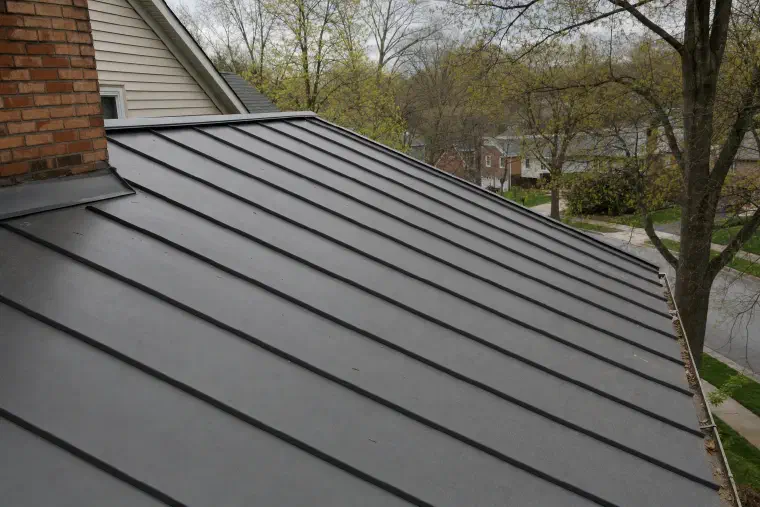
A standing seam metal roof is a roof made of long metal panels that lock together along raised seams, with the fasteners hidden underneath instead of showing on top. The panels often run in one piece from the ridge down to the eave. That one idea, no screws out in the rain, is the reason people pay more for it.
The short version
- The seams stand up from the roof, and the panels are held down by clips tucked inside them.
- No screw heads on the surface means no rubber washers to wear out.
- The panels can slide a little as the metal heats and cools.
- It typically costs two to two and a half times what asphalt does.
- It only works well when the details at chimneys, walls and valleys are done right.
How is a standing seam roof put together?
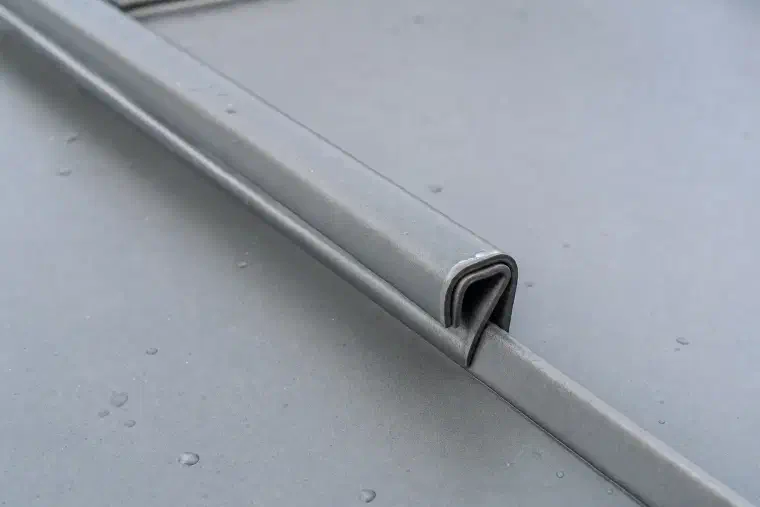
Each panel is clipped to the roof, and the next panel locks over the clip and onto its neighbor. The Building America Solution Center says standing seam panels are attached to clips (opens in a new tab) that are attached to the roof, and that the seams lock the panels together. The Insurance Institute for Business & Home Safety puts it plainly: the clips are concealed in the seam (opens in a new tab) of the panel.
What you see from the yard is a flat painted surface with narrow ribs running up and down the slope. The clips, and the screws that hold them, are all underneath.
What makes it different from a metal roof with visible screws?
The fasteners. Most cheaper metal roofs are exposed fastener panels, where a screw goes through the face of the metal with a small rubber washer under its head. A standing seam roof has none of those on the surface.
That matters because the washer is the part that gets old first. We cover that in why metal roof screws leak. With standing seam, most of that list of leak causes goes away. The trouble spots move to the places where the roof meets something else, like a chimney, a wall or a skylight.
| Standing seam | Exposed fastener | |
|---|---|---|
| Screws on the surface | None | Every few inches |
| Washers to wear out | None on the panel face | Yes |
| Look | Smooth, with narrow raised seams | Ribs with visible screw heads |
| Cost | Higher | Lower |
Do the panels move when it gets hot?
Yes, and a good standing seam roof is built to allow it. Metal grows in summer heat and shrinks on a cold night, so a panel pinned down hard at every point has nowhere to go. IBHS says sliding clips allow the roof to expand (opens in a new tab) and contract.
Keep in mind that this is a detail a roofer has to get right. We say the installer matters more than the brand of panel, and this is a good example of why.
What does a standing seam metal roof cost?
It typically runs two to two and a half times what asphalt shingles do. Asphalt around Ellicott City typically runs $6.00 to $9.00 per square foot installed, so standing seam lands well above that. National guides give a wider spread, saying cut-to-size standing seam roofs cost $9 to $30 per square foot (opens in a new tab), which shows how much depends on the roof.
The full breakdown is in our article on how much a metal roof costs. These are typical ranges, not a quote. Roof shape, steepness and trim work move the price more than the metal does.
Can a standing seam roof go on a low slope?
Often yes, which is a big reason people choose it. The Building America Solution Center says the minimum slope for standing seam roof systems is one quarter unit in 12 (opens in a new tab), which is a very gentle pitch. Shingles can’t legally go on a section lower than 2/12, and standing seam is one of the options for those sections, along with modified bitumen and TPO. That kind of work is often subcontracted at $2,500 to $5,000 minimum.
Each product has its own minimum, so the maker’s sheet decides, not the general rule. Our article on metal roofs on flat roofs goes further into this.
How long does a standing seam roof last?
Metal roofs in general can last up to 70 years (opens in a new tab), and the same article says they need little maintenance if installed correctly. Those last three words do a lot of work. Asphalt shingles in Maryland realistically last 18 to 25 years, so the gap is real, but only if the roof is put on properly.
Where does a standing seam roof still leak?
At the places where something goes through or against it. IBHS warns that penetrations that cut through the seam of the panel are a potential source of water infiltration (opens in a new tab), and says roof penetrations should be placed to avoid the seams.
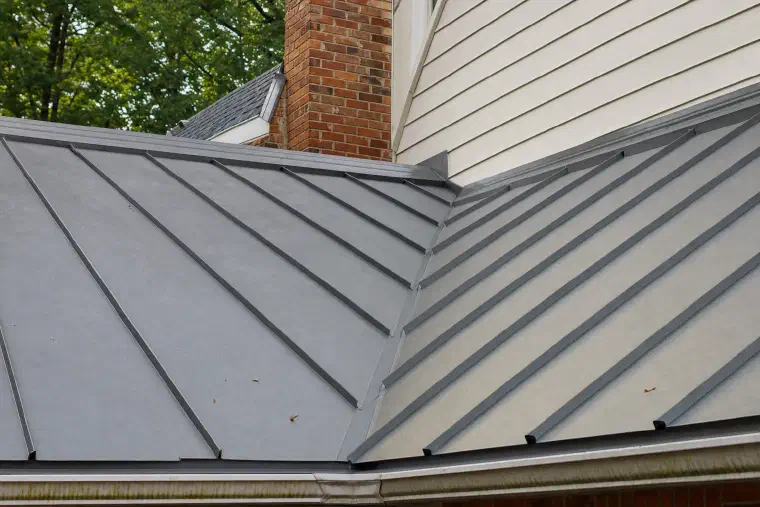
Chimneys, skylights, pipes and valleys all need custom trim. We say caulk is a scheduled leak, because anything that depends on sealant has a life of about 5 to 10 years. On a metal roof the trim should be built so the metal does the work and the sealant only backs it up.
Common questions
Is standing seam the same as a hidden fastener roof?
Mostly, yes. Standing seam panels hide their fasteners under the seams, so people use the two names for the same thing. Some other metal panels also hide their screws, so check which one a quote means.
Does standing seam need a solid deck under it?
Usually. The Building America Solution Center says standing seam panels typically must be installed on roof decks (opens in a new tab) with sheathing. That is also why the old deck gets a look before the metal goes on.
Is it worth the extra money?
It depends on how long you plan to stay and what your roof looks like. A simple roof you will keep for decades suits it well. A cut-up roof with many valleys adds labor and trim, which pushes the price up fast. We would rather tell you honestly that shingles make sense than sell you metal you don’t need.
What to do next
If you are weighing standing seam, start with a free roof inspection so you know what your roof and deck are like today. Then our metal roofing installation page shows who metal suits and who it doesn’t. You can also call us anytime, day or night.


