

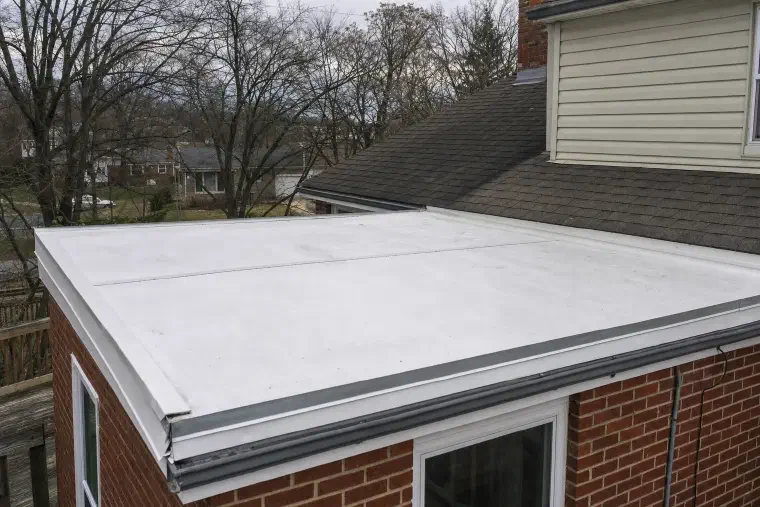
A TPO roof is a flat or low-slope roof covered in one large sheet of white plastic-like membrane, with the seams melted together by hot air. TPO stands for thermoplastic polyolefin, which is just the name of the material. It is made for roofs that are too flat for shingles.
The short version
- TPO comes in wide rolls and covers a flat roof in one continuous skin.
- The seams are heat-welded, so they become part of the sheet instead of a taped joint.
- It is usually white, which reflects summer sun.
- It suits flat roofs on additions, porches, garages and row homes, not a normal pitched roof.
- Most leaks on one start at a seam, an edge or a penetration, so the install matters more than the label.
What is TPO roofing made of?
TPO is a single-ply membrane, meaning one layer of manufactured sheet instead of many layers of tar and gravel. The Department of Energy describes single-ply membranes as prefabricated sheets rolled onto the roof (opens in a new tab) and attached with mechanical fasteners, chemical adhesives, or ballast, which is gravel, stones or pavers holding the sheet down.
Most new flat roofs we put on are a single-ply membrane, and TPO is one of the common kinds. The sheet itself sits on a base or insulation boards, so what you see from a window is only the top skin.
Why are TPO seams welded?
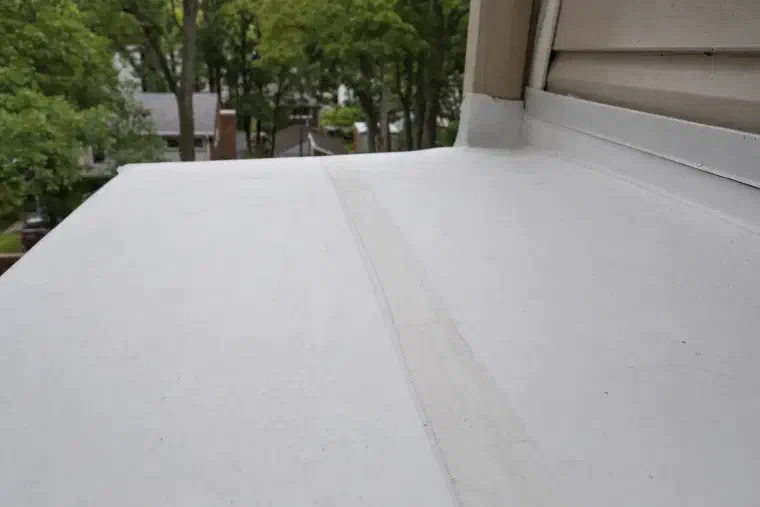
TPO seams are welded because the material is a thermoplastic, which means heat softens it and lets two edges fuse. Hot air melts the overlap, a roller presses it flat, and the join becomes part of the sheet. The Insurance Institute for Business & Home Safety says thermoplastic membranes have seams formed using heat or chemical welding, and that these seams are as strong as or stronger (opens in a new tab) than the membrane itself.
That is on a good day. A weld depends on a clean sheet, the right temperature and a steady hand, and a skipped patch is invisible from above. This is why we care who does the seams, in the same way we care who does the nailing on a shingle roof.
Why is a TPO roof white?
TPO is usually white because white reflects sunlight, and a cooler roof sends less heat into the rooms under it. The Department of Energy says TPO and PVC membranes are usually white and reflective (opens in a new tab) without extra coatings. Its consumer guide says a white roof reflects up to 90% (opens in a new tab) of the sunlight that hits it.
There is a trade-off. The EPA notes that cool roofs may increase winter heating use (opens in a new tab) in cold climates, though it says summer cooling savings typically offset that. For a flat roof over a garage, you will likely never notice either way. Over a bedroom addition in July, you might.
Can you put a TPO roof on a pitched roof?
Not in the usual way. TPO is for flat and low-slope roofs, and shingles are for pitched ones. The Insurance Institute for Business & Home Safety points out that the building code requires single-ply membranes to have a design slope of at least 1/4:12 (opens in a new tab), which is a gentle fall of a quarter inch for every 12 inches. A flat roof is never truly flat, because water has to have somewhere to go.
On the other side, shingles cannot legally go on a section flatter than 2/12. When a house has a low porch roof joined to a steep main roof, that low section needs modified bitumen, TPO or standing seam metal. That part is often subcontracted at a minimum of $2,500 to $5,000, which is a typical range for work around Ellicott City, not a quote.
If you are not sure what pitch your roof has, our article on how to find the pitch of your roof shows how to measure it.
How does TPO compare with other flat roofs?
TPO is one of several flat roof options, and each one differs mostly in how the seams are joined and how the surface looks. Here is the simple version.
| Roof type | How the seams are joined | Usual look |
|---|---|---|
| TPO | Heat-welded | White |
| PVC | Heat-welded | White |
| EPDM | Glued or taped | Black, or sometimes white |
The Department of Energy notes that EPDM membranes are black (opens in a new tab) but can also be made in white or cool colors. For a house, the questions that matter are the roof’s size, what sits on it and what you are trying to avoid. A good installer picks the roof for the job, and we do not push one product on every flat roof.
Where do TPO roofs leak?
They leak at the same places every flat roof does, which are seams, edges and anything that pokes through. The sheet in the middle is rarely the problem. Pipes, vents, skylights and the edge where the roof meets a wall are where water gets in, and they all depend on flashing, the metal or membrane strips that seal those joints.
A low-slope membrane repair typically runs $2,500 to $6,000 in our area, according to the ranges we work from. That is a bigger number than a shingle patch, because the repair is scoped to a seam or an edge and the membrane has to be welded back into the roof properly. If you see a stain inside, our flat roof repair page covers where flat roofs fail and how we fix them.
Keep in mind that caulk on a flat roof is a scheduled leak, same as anywhere. Sealant has a life of about 5 to 10 years, so a flat roof patched with a tube of it every summer is telling you something.
Common questions
Is TPO the same as rubber roofing?
No. Rubber roofing usually means EPDM, which is a thermoset rubber that cannot be melted and re-fused. TPO is a thermoplastic, so its seams can be welded. They look different too: EPDM is typically black and TPO is white.
Do I need TPO for a small porch or addition?
Not always. Any flat roof needs a membrane that suits the job, and TPO is one good answer. The roof size, access and what sits on it decide the rest, and we would rather look at the roof than guess over the phone.
Can a TPO roof be walked on?
Light foot traffic is part of life on a flat roof, such as a technician servicing a unit. But every extra trip scuffs and stresses the surface, and every person who walks the roof is a chance for a puncture. Ask whoever goes up to be careful near seams and edges.
What to do next
If you have a flat roof going bad, or a low section the shingles can’t cover, call us and we will walk it and tell you what we see. The free roof inspection includes a boots-on-the-roof look and a written report with photos. When it is time for a new one, our flat roof installation page explains what we put on and where.


