

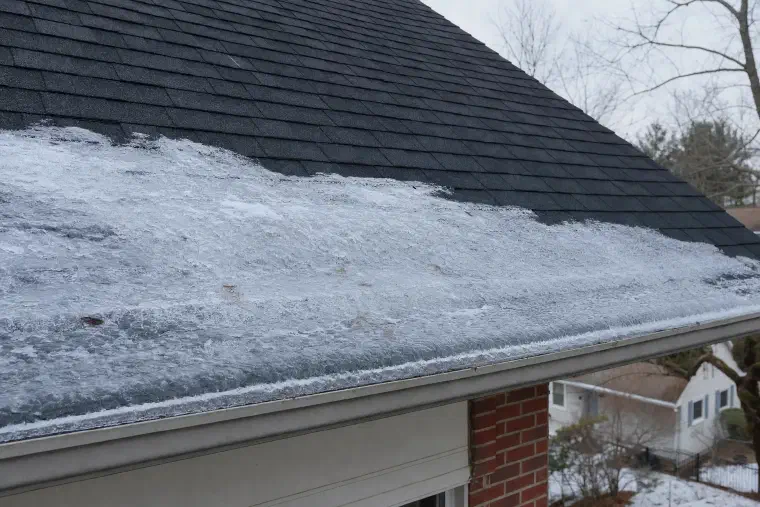
An ice dam is a ridge of ice that builds up along the edge of your roof and stops melting snow from draining off. The trapped water has nowhere to go but under your shingles. It’s one of the few roof problems that shows up in the middle of winter, with no rain in sight.
The short version
- An ice dam forms when the upper roof melts snow and the cold edge freezes it again.
- The warmth usually comes from your house, through the attic, not from the sun.
- The water backs up behind the ice and gets under the shingles.
- A leak can wet your attic insulation, ceilings and walls.
- Even a well-built roof can get one, but a leaky, under-insulated attic makes it far more likely.
What is an ice dam?
An ice dam is ice that collects at the lowest edge of a roof and blocks meltwater from running off. The Department of Energy’s Building America program defines it as an accumulation of ice (opens in a new tab) at the eave that prevents melted snow from draining off the roof.
Think of a clogged drain in a sink. The water is still coming, it just can’t leave. Meltwater pools behind the ice, and a roof is built to shed water downhill, not to hold a pond.
What does it take to make an ice dam?
It takes three things at once. Building America lists them as snow on the roof (opens in a new tab), a poorly air-sealed or poorly insulated attic, and freezing temperatures. Take away any one and the dam doesn’t form.
| Ingredient | What it means | Who controls it |
|---|---|---|
| Snow on the roof | Something has to melt | The weather |
| Heat reaching the roof deck | Warm air from the house leaks into the attic | You, and your attic |
| Freezing air outside | The edge of the roof stays colder than the middle | The weather |
You can’t change the weather, so the middle row is where the work is. University of Massachusetts guidance describes the pattern: the upper roof is above freezing (opens in a new tab) while the eaves are below freezing, so snow melts up high and the water refreezes at the edge.
Why does an ice dam make a roof leak?
Shingles shed water that runs down them. They don’t seal against water that’s pushed or pooled behind them. Building America says water behind a dam can be drawn up beneath the shingles (opens in a new tab) by capillary action, which is the same thing that pulls water up a paper towel.
The Asphalt Roofing Manufacturers Association says the same thing from the shingle side: water can be forced under the roofing materials (opens in a new tab). Once it’s past the shingles, University of Minnesota Extension says it finds cracks and openings (opens in a new tab) in the roof covering and flows into the attic.
The annoying part is the timing. The leak shows up when it’s freezing and dry, so it rarely looks like a roof problem to the person standing under the stain.
What can an ice dam damage?
Mostly the inside of the house. Minnesota Extension says the water can damage walls, ceilings and insulation (opens in a new tab), and that the moisture can lead to mold and mildew. The Asphalt Roofing Manufacturers Association adds long-term damage to structural parts (opens in a new tab) of the home.
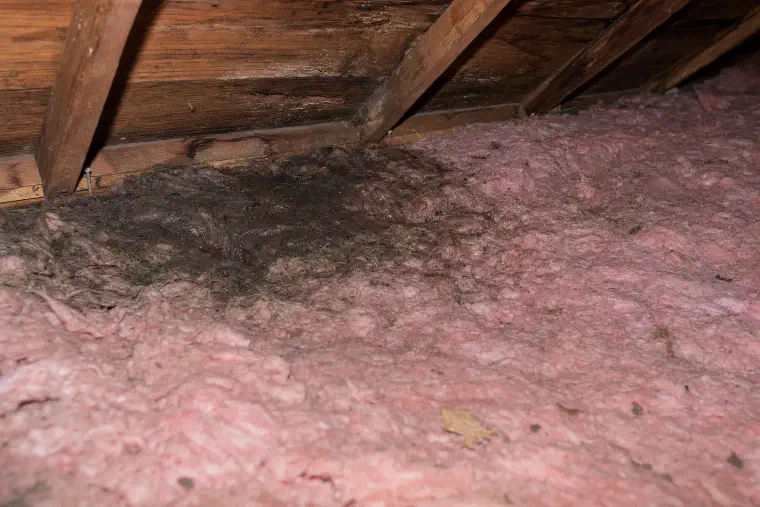
Wet insulation is the quiet one, because you can’t see it from the living space. UMass notes that paint can peel long after (opens in a new tab) the ice and all signs of a leak have dried away, so a stain in spring may belong to a January dam.
Gutters carry some of the blame in our experience. A gutter packed with leaves and standing water gives the ice something to build on. We cover that side in ice dams in gutters.
Does a roof with an ice dam have something wrong with it?
Not always, but often the attic does. UMass says even well-built roofs (opens in a new tab) can get ice dams, because deep snow acts like a blanket and warms the roof deck. The same source says a dam can start with 1 or 2 inches of snow (opens in a new tab) on a leaky, poorly insulated roof followed by several freezing days.
What we see most is an attic that leaks heat and doesn’t get cold air. Ridge vents installed with the soffits never cut open. Insulation pushed against the roof edge, blocking the intake. A bath fan that ends inside the attic. All three keep the roof deck warm. Poor ventilation is the most underrated roof problem we deal with, and it drives ice damming in winter.
How do you know you have an ice dam?
Look at the edge of the roof after a cold stretch. A thick band or ridge of ice sitting along the eave, with snow behind it, is the sign. If the ice is there and the ceiling below is damp, have the attic looked at before the next freeze.
Winter is also the best time to look at an attic. Frost on the underside of the roof boards on a cold morning means warm, damp air from the house is getting up there. That’s the same leak of heat that makes a dam.
Common questions
Is an ice dam the same as an icicle?
No. An icicle is ice hanging off the edge. An ice dam is a solid ridge of ice on the roof that holds water back. They often show up together, but it’s the dam that sends water under the shingles.
Can ice and water shield stop an ice dam?
It doesn’t stop the dam, but it’s the backup that stops the leak. The Asphalt Roofing Manufacturers Association recommends a protection layer along the eaves, extended at least 24 inches (opens in a new tab) inside the interior wall line. We explain the product in what ice and water shield is.
How do I get rid of one that’s already there?
Carefully, and from the ground. UMass warns that people attack roof ice with tools, and more damage is done (opens in a new tab) to people and roof than to the ice. Our guide on how to remove an ice dam walks through what is safe, and how to prevent ice dams covers the fix that lasts.
What to do next
If you get ice at the eaves every winter, the cause is usually in the attic, not on the roof. Our attic venting page explains how we fix airflow, and our free roof inspection includes a look at the attic when it’s safe to get in.


