

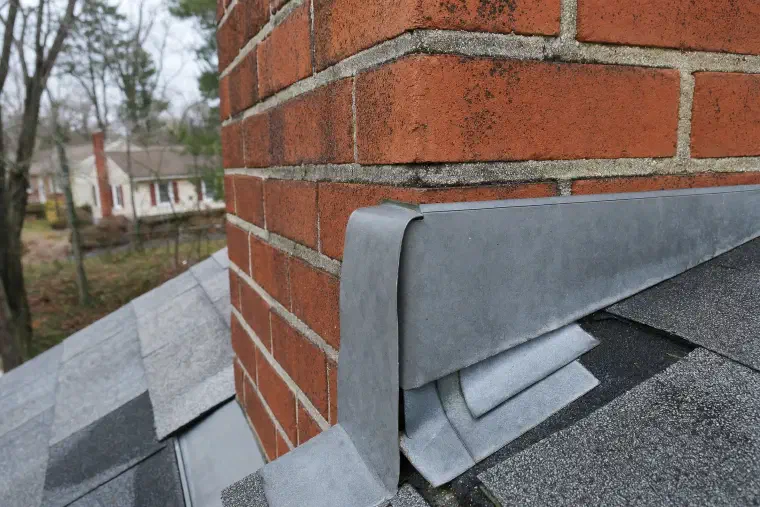
Counter flashing is the second piece of metal that covers the top edge of the flashing below it, so rain runs over the joint instead of into it. You find it on chimneys and where a roof meets a wall, and it does one job: keep water out of the gap between the roof and whatever sticks up through it.
The short version
- Counter flashing is the top layer. The flashing under it is called base flashing or step flashing.
- On a chimney, the best version is bent metal tucked into a slot cut in the mortar, called a reglet.
- Caulk smeared over the joint is a patch, not counter flashing. We see it fail constantly.
- It is also called cap flashing.
- A chimney leak is rarely the bricks. It is usually this joint.
What does counter flashing do?
Counter flashing hangs down over the upper edge of the flashing underneath, like the brim of a hat. This Old House describes it as (opens in a new tab) a layer commonly placed on top of step flashing, and says it is also called cap flashing.
The bottom layer is nailed to the roof. The top layer is fixed to the wall or the chimney. Keep that split in mind, because it is the whole trick. The two pieces overlap but are not joined, so they can shift a little without opening a gap.
Why are there two layers instead of one?
A chimney and a roof move at different speeds. They heat, cool, swell and settle on their own schedules. The asphalt shingle makers’ manual explains (opens in a new tab) that if movement occurs, the counter flashing slides over the apron flashing without affecting water runoff.
One rigid piece of metal glued to both would tear loose the first hard winter. Two pieces that slide past each other keep working. If you want the lower layer explained, our piece on step flashing covers it.
What is a reglet?
A reglet is a thin slot cut into a mortar joint of the brick, deep enough to hold the top edge of the counter flashing. A roofer bends the metal, slides it into the slot, wedges it so it stays put, and fills the slot with matching mortar or a sealant made for masonry.
The metal ends up locked into the chimney itself. That is what This Old House means (opens in a new tab) when it talks about a second layer of metal embedded in the chimney mortar joints. The Pacific Northwest National Laboratory (opens in a new tab) shows the same idea: the upper counter flashing goes into the mortar joints and overlaps the base flashing nailed to the roof deck.
Is caulk the same as counter flashing?
No. Caulk is a sealant, and a sealant is not a substitute for metal that overlaps. This Old House puts it plainly (opens in a new tab): caulk is not a substitute for properly overlapped flashing materials.
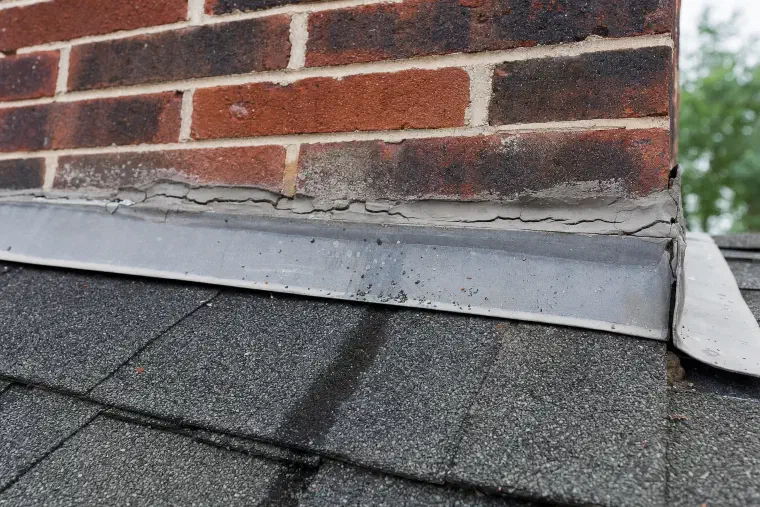
Here is the annoying part. A chimney with L-shaped metal pressed against the brick and a thick bead of caulk along the top looks sealed from the ground. It even works for a while. Then the caulk dries, shrinks and pulls away. We treat any flashing detail that depends on sealant as a scheduled leak, because caulk is a consumable with a life of roughly 5 to 10 years.
| Cut reglet with counter flashing | Caulk on the brick | |
|---|---|---|
| How it holds | Metal locked into the mortar joint | Sticky bead on the brick face |
| Handles movement | Yes, the layers slide | No, it cracks or peels |
| Typical life | Outlasts the sealant | Roughly 5 to 10 years |
| Upkeep | Check it now and then | Redo it again and again |
| Cost today | Costs more up front | Costs less up front |
Where else is counter flashing used?
Anywhere a roof meets something that stands up. On a brick chimney it is the metal in the mortar. Against a siding wall, the siding often does the job. The shingle makers’ manual says to bring siding down at least 2 inches over the vertical flashing to serve as counter flashing (opens in a new tab).
That is also why siding that sits too tight on a roof can cause trouble. It needs room to hang over the flashing and room to dry.
What does a failing counter flashing look like?
You can often spot it from the ground with binoculars, or from a ladder if you are comfortable on one. The signs:
- A gray or black bead of caulk along the chimney, cracked or pulled away
- Metal that is rusted, lifted or loose in the mortar line
- A water stain on the ceiling or the chimney wall inside, usually after wind-driven rain
- Mortar crumbling at the slot, or gaps in the brick
This Old House suggests (opens in a new tab) checking for loose or missing flashing and cracks in the masonry every year or two. If the mortar itself is crumbling, the flashing has nothing to hold on to, and that is a mason’s repair first. Our article on the chimney crown covers the other masonry piece that leaks.
What does it cost to fix?
A chimney reflash typically runs $800 to $2,200 in our area. That is a typical range around Ellicott City, not a quote. Repointing or rebuilding masonry is separate, and a chimney rebuild with new flashing typically runs $3,500 to $8,000.
A wide chimney often needs a small peaked roof behind it, called a cricket, to push water around. The shingle makers’ manual (opens in a new tab) strongly recommends one on any chimney 24 inches wide or more, and says the International Residential Code requires one over 30 inches.
Common questions
Is counter flashing the same as cap flashing?
Yes. Counter flashing and cap flashing are two names for the same top layer.
Can I re-caulk the chimney?
If the metal is sound, fresh caulk can slow a small leak for a few years. This Old House notes (opens in a new tab) that recaulking can take care of the problem when the flashing is in good condition. It will not fix flashing that was never cut in.
Does a new roof include new counter flashing?
Our roof installation includes new flashing at chimneys, walls, valleys, skylights and penetrations, unless the plan says to reuse it. Ask any roofer you hire whether the chimney flashing is new, and whether it is set into the mortar or caulked on.
Why does my chimney leak only in hard, windy rain?
Wind pushes water sideways into small gaps that stay dry in a gentle rain. A cracked caulk line or a loose edge of metal shows up that way first.
What to do next
If you see caulk where metal should be, or a stain near the chimney, have it looked at before the next storm season. Our chimney flashing repair work sets new metal into the brick, and a free roof inspection will tell you what you have.


