

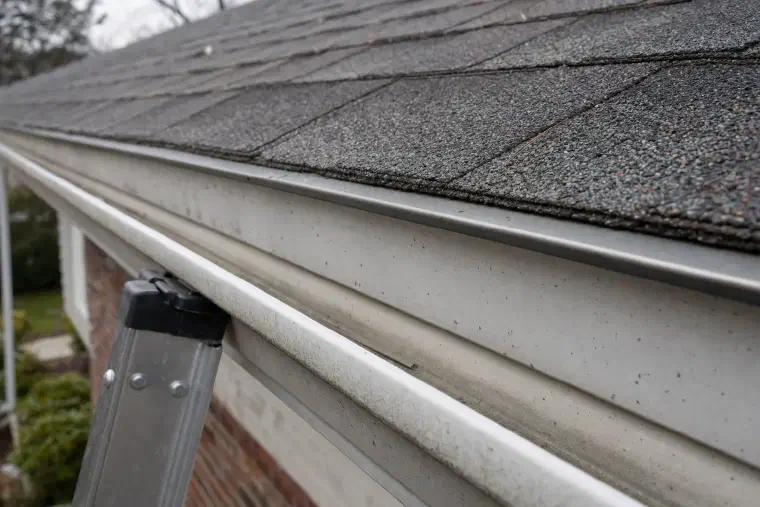
Drip edge is a thin strip of bent metal that runs along the edges of a roof. Its job is to push rain off the roof and away from the wood underneath, so water drops into the gutter instead of crawling back behind it. Most people never notice it until a roofer points it out, or until the wood at the edge starts to rot.
The short version
- Drip edge is L-shaped metal flashing fastened along the eaves (the bottom edges) and the rakes (the sloped side edges) of a roof.
- It keeps water off the fascia board and the roof deck, which is where edge rot starts.
- The model building code asks for it on shingle roofs, and it is still one of the things we see skipped.
- It is cheap next to the damage it prevents, and a new roof from us includes it.
- You can often spot a missing one from the ground.
What does drip edge do?
It gives water a clean place to leave the roof. Without it, rain running off the last shingle can curl under the edge and cling to the wood. This Old House says a drip edge’s primary purpose is to prevent wood rot (opens in a new tab) and water damage, by keeping moisture from getting under the first row of shingles and steering it away from the fascia and into the gutter.
The bent lip at the bottom matters more than it looks. It is called a kicker, and it makes water droplets fall away from the fascia (opens in a new tab) rather than running down it. Water is stubborn, and it will follow any surface that lets it.
Where does drip edge go on a roof?
It goes on every edge of the roof, in two places: the eaves along the bottom and the rakes up the sloped sides. The eave is where the roof meets the gutter. The rake is the edge on the gable end of a house, the triangle end wall.
The order of the layers is different on each one. A building department memo quoting the 2018 International Residential Code says underlayment goes over the drip edge (opens in a new tab) along the eaves and under it along the rake edges. That makes sense once you picture the water. At the eave it runs down and out, so the metal sits under the underlayment and the water passes over it. On the rake, wind-driven rain gets pushed under the edge, so the metal sits on top to shed it.
Our article on what roof underlayment does covers that sheet in more detail.
Is drip edge required by code?
For shingle roofs, the model code says yes. The same memo quotes the code in plain terms: a drip edge shall be provided at eaves and rake edges (opens in a new tab) of shingle roofs. It also spells out how it goes on. Pieces overlap by at least 2 inches, the metal runs at least 2 inches back up the roof deck, and it is nailed down at no more than 12 inches apart.
That memo comes from a building department in Georgia, and it says a roof inspection fails if the drip edge is missing. Rules differ by place and by which code edition a county has adopted. Ask Howard County’s permit office what applies to your address, or ask your roofer to show you where the drip edge is on the quote.
We put the point plainly: drip edge is code-required, and it still gets skipped. Missing drip edge is one of the shortcuts we find on roofs a previous contractor worked on, along with a missing starter strip at the eaves and rakes.
What types of drip edge are there?
There are three common shapes, and two of them cover most houses. A Type C is also called L-style, an L-shaped piece of metal (opens in a new tab) bent at a 90-degree angle. Type D is T-style, and the top of the T extends further out over the gutter (opens in a new tab). Type F has a longer leading edge that makes it easier to fasten over existing shingles.
| Metal | Cost per linear foot | What to know |
|---|---|---|
| Aluminum | $0.30 to $1 | Light, resists corrosion, not as strong |
| Galvanized steel | $0.50 to $1.20 | Slightly pricier, holds up better in strong wind |
| Copper | $3.50 to $7.50 | Most expensive, very durable |
Those are material prices from This Old House, not what a job costs. The metal is a small line next to the shingles and labor on a full roof.
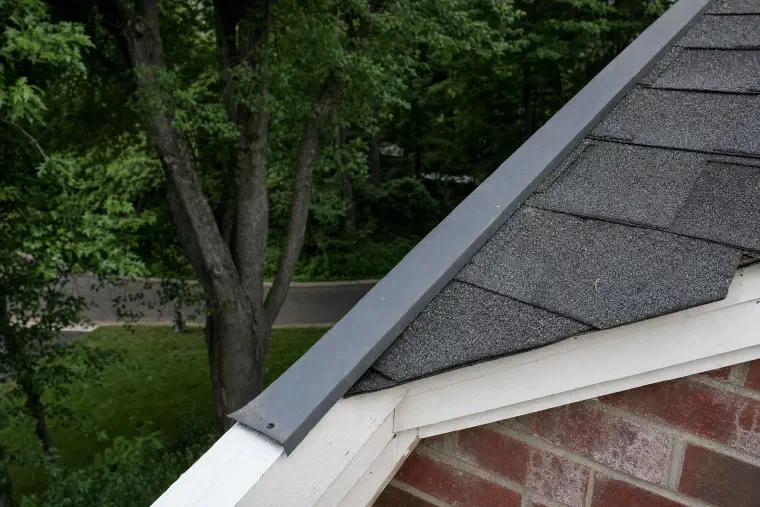
What happens when a roof has no drip edge?
The wood at the edge takes the hit. Water that sneaks behind the gutter runs down the fascia, and the fascia is wood. This Old House also says a drip edge reduces ice dam risk (opens in a new tab), which matters with the freeze and thaw we get in Ellicott City.
Edge rot is slow and quiet. Rotted fascia leads to rotted rafter tails and then the first few inches of decking, and from the ground you may see only a gutter that has started to sag. We cover that chain in our article on why a fascia board rots.
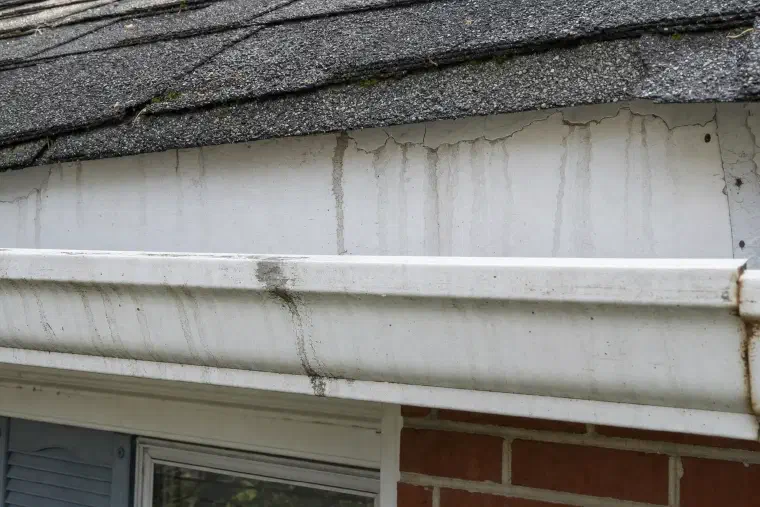
Can you tell if your roof has drip edge?
Often, yes, and you do not need a ladder. Stand back and look along the bottom edge of the roof. A thin metal lip, usually white, brown or gray, should show just above the gutter. If the shingles end at bare wood and the fascia looks stained or flaky right below, that is a warning.
Two cautions. Some roofers match the metal to the trim, so it can hide in plain sight. And a drip edge can be there but installed wrong, say too short or on the wrong side of the underlayment, which you cannot judge from the lawn. A free roof inspection from us includes a walk on the roof and a look at the edges.
Common questions
Can drip edge be added to an existing roof?
Sometimes. Type F is made with a longer leading edge for just that case, since it can be fastened over existing shingles. It is a patch, though. The right order of layers only happens during a tear-off, when the metal goes on the bare deck.
Does drip edge stop leaks?
Not by itself. It protects the edges and the wood behind the gutter. Leaks in the middle of the roof come from flashing, valleys and vents, which is a different problem.
Is drip edge included in a new roof?
With us, yes. Our roof replacements include new drip edge, along with starter strip and the shingles. Rotted fascia and trim carpentry that we find are separate, because nobody can see that wood until the work starts.
What to do next
If you are getting quotes for a new roof, ask where the drip edge goes and whether it is new. It is a one-line answer, and a roofer who hesitates has told you something. Our roof installation page lists what a full replacement covers.


