

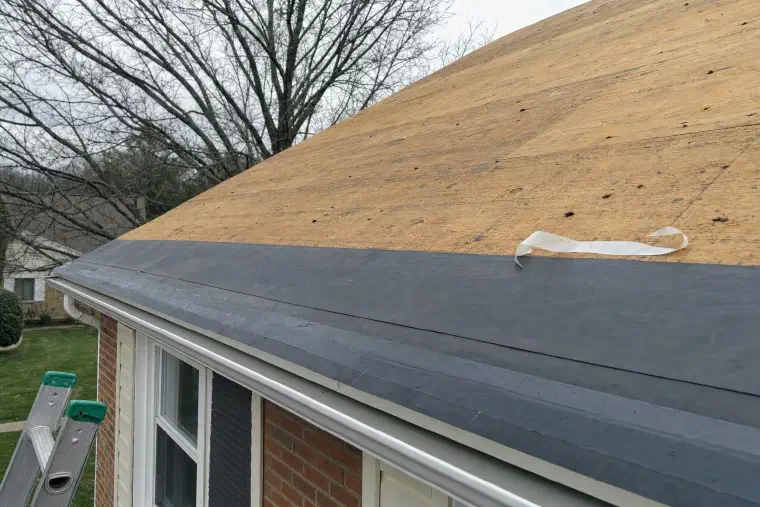
Ice and water shield is a sticky, waterproof sheet that goes under the shingles at the parts of a roof where water backs up or gathers: the bottom edge, the valleys, and around chimneys, skylights and pipes. It seals itself to the wood and around every nail, so water that gets past the shingles still cannot reach the house.
The short version
- It is a self-adhering rubberized asphalt membrane, stuck straight to the roof deck under the shingles.
- Its main job is stopping leaks from ice dams at the eaves, where code requires it in cold-winter areas.
- It should run at least 24 inches inside the wall line, and a short strip is one of the most common shortcuts we find.
- It stops the leak, not the ice dam. Attic heat and airflow decide whether the dam forms.
- Covering the whole roof with it is not automatically better, and can trap moisture.
What is ice and water shield made of?
Ice and water shield is a sheet of rubberized asphalt with a sticky back and a textured or film top. Roofers peel off a release film and press it straight onto the bare wood deck, where it bonds like a giant piece of tape. The asphalt adhesive seals around the nails (opens in a new tab) driven through it for the shingles above, which is the whole point. Ordinary underlayment has a hole in it at every nail.
You will hear it called a few names. Roofers say ice and water shield, manufacturers call it a leak barrier, and building codes call it an ice barrier. Same sheet every time.
How is it different from regular underlayment?
Regular underlayment sheds water, and ice and water shield holds it back. Felt or synthetic underlayment is nailed down in overlapping rows, so it works as long as water is running downhill across it. That covers most of a roof, most of the time.
The trouble starts when water stops running downhill. Snow melting behind a ridge of ice, or rain piling into a valley, can sit on the roof and push sideways and up under the shingles. Nailed underlayment leaks at the nails and the laps when that happens. A self-adhering sheet does not, because there is no gap for the water to find.
When we replace a roof, synthetic underlayment covers the deck, and ice and water shield goes in at code minimum: the eaves, the valleys and around penetrations. Both are part of the replacement, not extras.
Where does ice and water shield go on a roof?
It goes wherever water can pool or back up, which on most houses means four places:
| Where | Why water gets in there |
|---|---|
| The eaves (the bottom edge) | Ice dams hold back melting snow, and the water backs up under the shingles |
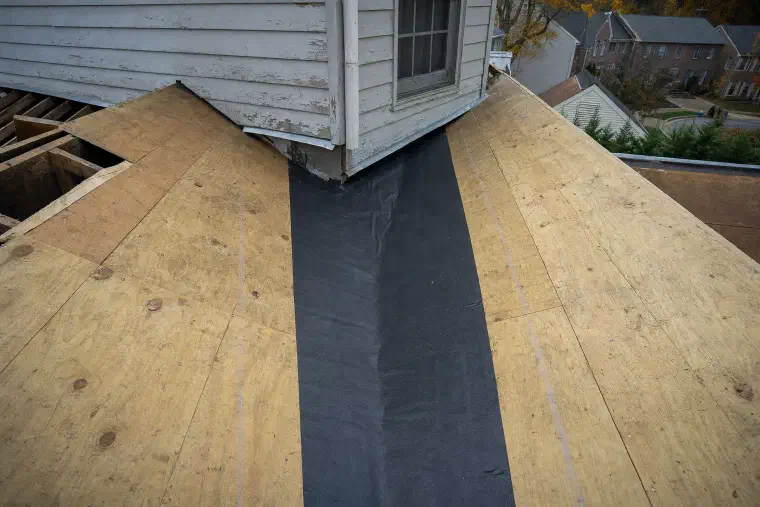
| Valleys | Two slopes pour into one channel, and leaves and snow slow it down |
| Around chimneys and skylights | Water piles against the upslope side, and the flashing is the weak point |
| Around vent pipes and other openings | Every hole in the roof is a place for water to follow the pipe down |
On a low-slope section, one that rises only 2 to 4 inches for every 12 inches across, codes call for either a double layer of regular underlayment or a single layer of self-adhering (opens in a new tab) membrane, because water moves slowly on a roof that flat.
How far up the roof should it go?
At the eaves, ice and water shield should run from the roof edge to at least 24 inches inside (opens in a new tab) the wall line of the house. In plain terms, it has to cover the overhang and then keep going for two feet over the heated part of the house, because that is where the ice dam holds water.
This is a detail we see skipped a lot. The code minimum is eave coverage, and it is often left out or run too short. A single width of membrane can end before it clears the wall on a house with a deep overhang, so the water backs up past it and onto plain underlayment. It is also commonly left out of valleys and around skylights and chimneys, which are exactly the places it is meant for.
The annoying part is that none of this shows from the ground. A roof with a short strip looks identical to one done right until the first winter with real snow, and then the stain appears on the ceiling near an outside wall.
Does ice and water shield stop ice dams?
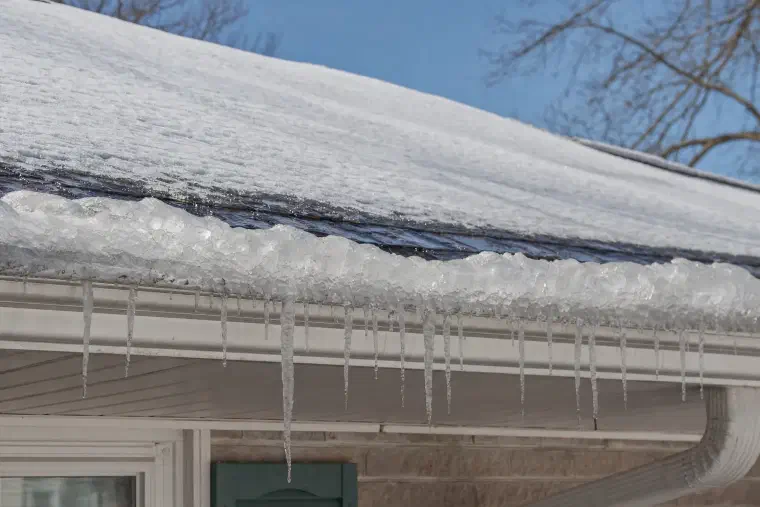
No. It stops ice dams from turning into leaks, but the dam itself still forms. Ice dams start when heat from the house (opens in a new tab) warms the upper roof, snow melts, and the water refreezes when it reaches the cold overhang. That ridge of ice keeps growing and holds back more water behind it.
So the real fix is in the attic. Warm, damp air leaking up through ceiling lights, bath fans and the attic hatch heats the roof deck from below. Poor ventilation makes it worse, and a ridge vent with no working intake at the soffits barely moves air at all. Attic venting that pulls cold air in low and lets it out high keeps the roof deck close to the outdoor temperature, which is what stops the melting in the first place.
Think of the membrane as the seatbelt and the attic as the driving. You want both.
Should the whole roof be covered in ice and water shield?
Usually not. Full coverage sounds like the safe choice, but the membrane does not let air or moisture pass through it. On a roof covered edge to edge, damp air from inside the house can condense on the underside (opens in a new tab) at the seams between deck boards, which can swell, stain and rot the wood.
That is a real risk here. Moisture rising into the attic already does a lot of quiet damage to roof decks around Ellicott City, and sealing the top of the deck gives that moisture one less way out. Full coverage makes sense on a low-slope section, and it is an upgrade beyond code minimum rather than part of a standard replacement. For most shingle roofs, the right amount in the right places beats more everywhere.
Adding it to a roof you already have
It can only go in by taking the shingles off where it needs to go. It sticks to the bare deck, so there is no sliding it under shingles that are already nailed down. For a roof that is otherwise in good shape, a roofer can strip the bottom few courses at the eaves, lay the membrane, and reshingle that strip. It works, but matching the old shingles is not always possible.
If the roof is near the end of its life anyway, it usually makes more sense to do it as part of a roof replacement than to pay for the eaves twice.
Common questions
Is ice and water shield required in Maryland?
Building codes require an ice barrier at the eaves in areas with a history of ice forming there, and freeze and thaw cycles are common around Ellicott City. The code minimum is the eaves. Valleys and the areas around chimneys, skylights and pipes are where it belongs too, even where code does not ask for it.
How long does ice and water shield last?
It lives under the shingles, out of the sun, so it is there for the life of the roof over it. Because it is bonded to the deck, it is never reused: a new roof gets new membrane.
Can I see whether my roof has it?
Not from the ground, and not from the attic either, because it is hidden between the deck and the shingles. A roofer on the roof can check the eaves, and our free roof inspection covers the roof edge, the valleys and the flashing, which are the places it belongs.
Why is my ceiling leaking near an outside wall in winter?
An ice dam at the eave is the usual suspect, especially if the stain shows up after snow rather than rain. It can also be condensation from the attic, which leaves a similar mark with no roof leak at all. Where the water appears and when tells you which.
What to do next
If you are getting quotes for a new roof, ask each roofer where the ice and water shield will go and how far past the wall it will run. A clear answer tells you a lot about the rest of the job. We put it in at code minimum as part of every roof replacement, and we are happy to walk you through where your house needs it.


