

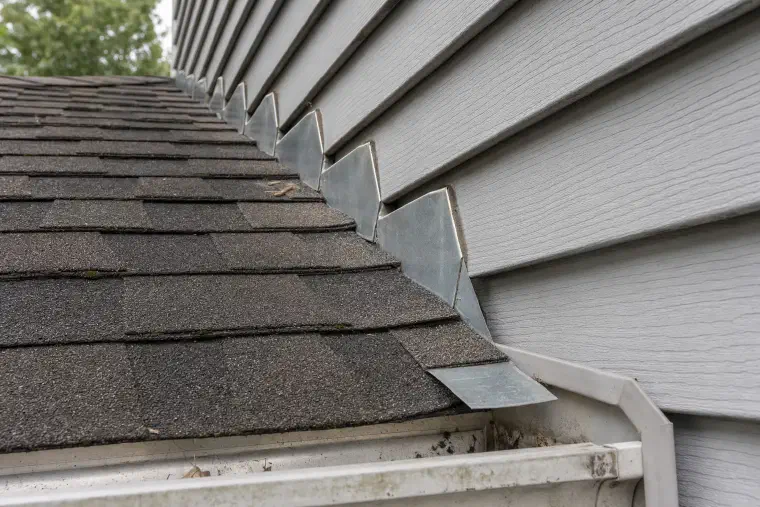
Kickout flashing is a small, angled piece of metal at the bottom of the spot where a sloped roof runs into a wall. Its one job is to knock the rain running down that joint out into the gutter, so it does not keep going straight down behind your siding. It is easy to miss, and as easy to leave out.
The short version
- Kickout flashing sits at the bottom end of the line where a roof meets a taller wall, right above the gutter.
- Without it, rain pours down the wall instead of into the gutter, and the damage stays hidden behind the siding.
- You can often spot trouble from the ground: dark streaks, stained siding, or a gutter that is dry where it should be wet.
- Fixing it early is a small job. Fixing rotted wall is not.
- It gets skipped, and it gets reused, so ask about it on any roof quote.
What does kickout flashing do?
It steers water away from the wall. Flashing is the metal that seals the joints on a roof, and along a wall it comes as a staircase of small pieces called step flashing. The Department of Energy’s building science team says kick-out flashing diverts rainwater into gutters (opens in a new tab) and protects walls from water getting in.
Think of step flashing as a slide for rain, running down the wall line. The kickout is the last bend in the slide. Building Science Corporation says it directs water away from the adjoining wall (opens in a new tab), so the step flashing is not dumping everything onto one spot of that wall.
Where does kickout flashing go?
At the bottom end of any line where a roof edge meets a wall and stops. The roof’s low edge hits the wall, the step flashing ends, and the gutter sits right there. That last spot is where the kickout goes.
You will find that spot in a few places:
- a garage or porch roof that runs into the side of a taller part of the house
- a dormer where its roof meets its own side wall
- the bottom corner beside a chimney that sits on an outside wall
The Pacific Northwest National Laboratory’s building science guide says to install it at the end of a roof-wall intersection (opens in a new tab) and fasten it to the roof deck and the starter strip, not to the wall.
What happens when kickout flashing is missing?
The water goes down the wall. Without a kickout, rain that has run all the way along the step flashing has nowhere to go but straight down behind the siding. The same guide says missing kick-out and step flashing has cost homeowners thousands of dollars (opens in a new tab) in damage, from rotting wood to water running into the wall during every storm.
The annoying part is that you do not see it. The Pacific Northwest lab notes that some sidings, including vinyl, fiber cement and brick veneer, can hide the evidence for years (opens in a new tab). The roof looks fine. The siding looks fine. Meanwhile the wall behind it is wet every time it rains hard.
We see this one constantly. Missing kickout flashing where a roof edge ends against a wall is one of the usual ways flashing gets done wrong, and flashing is where roofs tend to leak.
How can you tell if yours is missing or wrong?
Look at the bottom corner where the roof meets the wall, and then at the siding below it. You can do most of this from the lawn.
| What you see | What it can mean |
|---|---|
| No angled metal piece at the bottom of the wall line | There may be no kickout at all |
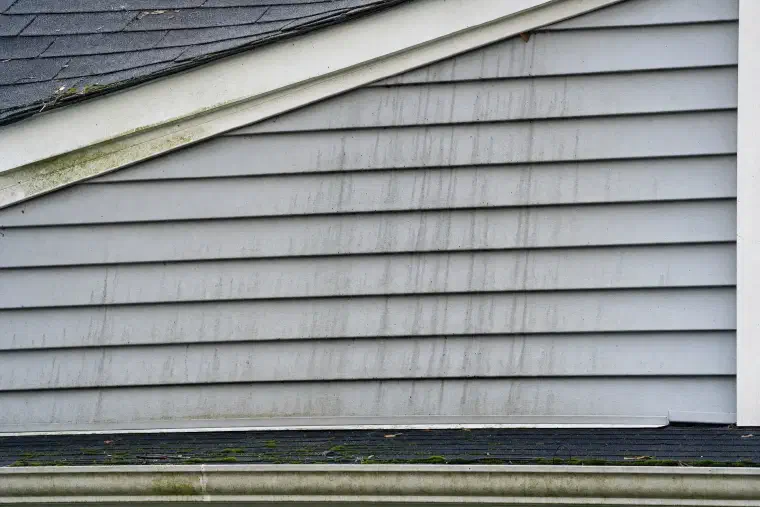
| Dark streaks or stains on the siding below the roof end | Water is running down the wall |
| Peeling paint, soft or swollen trim at that corner | Water has been getting in for a while |
| Gutter below is dry after a rain, or the wall is wet | The water is missing the gutter |
| A kickout that is tiny, flat or bent back | It is not steering the water into the gutter |
The government guide says an existing kickout should be checked for size and angle (opens in a new tab), and for any holes, even pinholes. It also says to look at the walls around it for holes and rot. A kickout that points at the wall instead of the gutter is only decoration.
Can you caulk it instead?
No. A blob of caulk is not a kickout, and caulk does not last. We think of it as a consumable: any flashing detail that depends on sealant to keep water out has a life of about 5 to 10 years, and then it becomes a leak on a schedule. A metal piece that bends the water out and into the gutter works with gravity, not against it.
That is also why we do not like roofs that reuse old flashing. Cheap bids often reuse the existing chimney, step and kickout flashing. New flashing is what lets the roof last. Our full roof replacements include new flashing at walls, valleys, chimneys, skylights and pipes unless the quote says otherwise.
What does it cost to fix?
We do not have a separate price for a kickout alone. Step flashing repair typically runs $700 to $1,900, and a kickout belongs to the same system, so it is looked at as part of that work. The price depends on the pitch, how high the wall is, and whether anyone has to work around siding or a gutter.
Rot is the part that changes the number. Wet decking found under a patch typically adds $150 to $500+, and wall repair behind the siding is a separate job from the roof. Our roof flashing repair page explains what a flashing job covers. For the wider picture on repair prices, see the average price of a roof repair.
Common questions
Is kickout flashing the same as step flashing?
No, but they work as a pair. Step flashing is the row of small bent pieces woven into the shingles along the wall. The kickout is the one piece at the bottom that sends the water out. A roof can have perfect step flashing and still soak the wall if the kickout is missing.
Can a missing kickout cause a leak inside the house?
Yes, though it often shows up as wall damage first. Water that runs behind siding can reach the wall’s framing and insulation, and can eventually show as a stain on an inside wall or ceiling. If you see that, start with the corner where the roof meets the wall.
Does a gutter replace the need for one?
No. The gutter catches the water the kickout sends its way. Without the kickout, the water runs down the wall and past the gutter, and a clean, new gutter does nothing about that.
Will a free inspection check for it?
Yes, it is part of what we look at. Our free roof inspection includes a walk on the roof and a look at the flashing, with no obligation to book work. Here is what a roof inspection includes if you want to know what to expect.
What to do next
Walk around the house after the next hard rain and look at every spot where a roof ends against a wall. If you see no metal piece, a stained wall, or a dry gutter, have it looked at before the siding tells you the rest. We can fit a kickout or replace a bad one, and our five most common roofing problems article shows where else water tends to get in.


