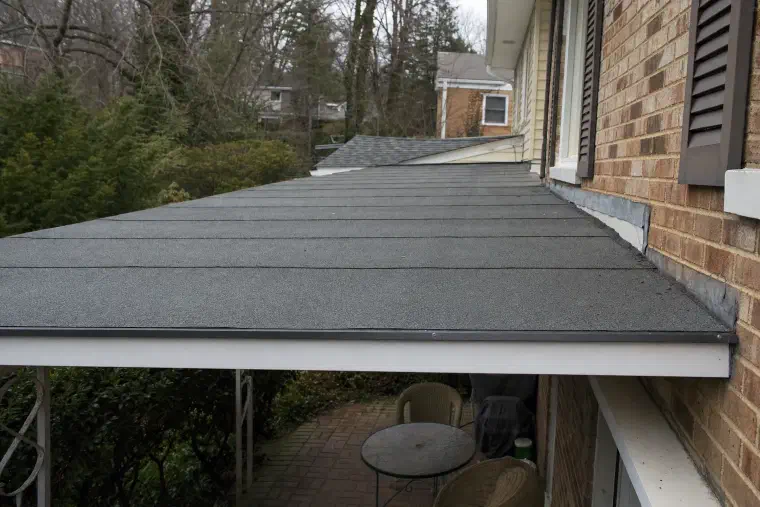
Modified bitumen roofing is asphalt roofing made in rolled sheets, with rubber-like plastic mixed in so it stays flexible. It goes on flat and low-slope roofs, the kind of roof that is too flat for shingles. Think of it as a tougher, stretchier cousin of the old tar-and-gravel roof.
The short version
- Modified bitumen is asphalt with added polymers, sold in rolls and laid in one or two layers.
- It is used on flat porches, additions and other sections too low for shingles.
- Sheets are fused with a torch, stuck down with adhesive, or peeled and stuck.
- It typically lasts 20 to 30 years if the seams and edges are looked after.
- The top surface needs protection from sun, either mineral granules or a coating.
What is modified bitumen made of?
Bitumen is the sticky, black, asphalt-based material that old tar roofs were made from. “Modified” means a plastic or rubber is mixed in. This Old House calls it an evolution of traditional asphalt roofing (opens in a new tab), and that is a fair way to picture it.
The Department of Energy describes the sheets as composed of one or more layers (opens in a new tab) of plastic or rubber with reinforcing fabric, surfaced with mineral granules or a smooth finish. The granules are the gritty gray chips you can see on top. They look a lot like the ones on a shingle, and they do the same job of shading the asphalt from the sun.
Where does modified bitumen go on a house?
It goes on the parts of a house that are too flat to shed water like a normal roof: a porch, a rear addition, a garage, a dormer top. Shingles cannot legally go on a section flatter than 2/12, which means two inches of rise for every 12 inches of run. If you are not sure what yours is, our article on how to find the pitch of your roof walks through it.
Below that pitch, the options are modified bitumen, TPO or standing seam metal. That kind of work is often subcontracted at a minimum of $2,500 to $5,000, which is a typical range for work around Ellicott City, not a quote.
How is modified bitumen put on?
There are three ways to get the sheets to stick. This Old House says the materials can be installed using torch-applied, cold-applied, or peel-and-stick methods (opens in a new tab).
| Method | How it works | What to know |
|---|---|---|
| Torch-applied | A flame heats the underside so the sheet melts onto the roof | Fast and strong, but it carries a fire risk |
| Cold-applied | Roofing cement or adhesive glues the sheet down | No open flame, slower to set |
| Peel-and-stick | A sticky backing is peeled off and pressed down | Common on small roofs and tight spots |
The fire risk is real. This Old House notes that torch-down methods can pose a fire risk (opens in a new tab) if not handled properly. On a house with a wood deck and an attic right underneath, ask how the crew handles it, or ask about a no-flame method.
Is modified bitumen a good roof?
It is a solid choice for the right roof. This Old House lists its upsides as an easier installation than traditional built-up roofs (opens in a new tab), a flexible material that handles temperature swings, and a surface that handles moderate foot traffic.
It also lists the downsides. The material is less resistant to scuffs and tears than some rubber membranes, and it may need more upkeep than a single-ply roof. So it fits a porch roof that someone walks on now and then better than a roof where the HVAC tech is up there every month.
Here is how it has held up on real roofs. The National Roofing Contractors Association looked at 109 roofs up to 13 years old across six climate areas and rated 76 percent as good or excellent (opens in a new tab). That survey is old and it covered only roofs up to 13 years, so read it as a decent sign and not a promise.
What is the difference between APP and SBS?
They are the two kinds of plastic or rubber mixed into the asphalt. APP stands for atactic polypropylene, a plastic. SBS stands for styrene butadiene styrene, a rubber. NRCA’s survey was of APP and SBS modified bitumen roofs (opens in a new tab), because those are the two you will meet.
You do not need to pick one yourself. What matters is that the roofer can tell you which one is going on and why. If the quote only says “flat roof material” with no name, that is worth a question.
Does modified bitumen need a coating?
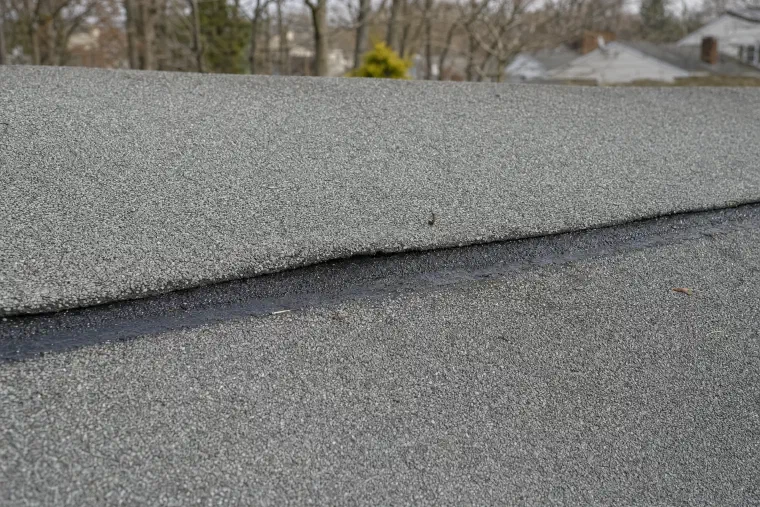
Yes, the top needs some kind of sun protection. The Department of Energy says modified bitumen roofs should have protective coatings (opens in a new tab) for heat, ultraviolet and fire resistance. It adds that an APP roof may be left unsurfaced, but that is not recommended because irregular surface cracks can develop and age the roof early.
That is why most sheets come with granules already baked on. White or light granules are also sold, which the same guide says cost a small premium (opens in a new tab) and reflect more heat. If a bare spot shows through where the granules have worn away, tell someone before the winter, because that is where the sun starts to eat the asphalt.
How long does modified bitumen last, and what does it cost?
This Old House says built-up and modified bitumen roofs last 20 to 30 years (opens in a new tab). Its cost table puts modified bitumen at $7 to $9 per square foot (opens in a new tab) installed, using estimates from a home cost site. That is a national guide, not a price for Howard County, so use it only for a rough sense.
On a small porch roof, the minimum charge matters more than the per-foot number. Getting a crew and materials to the house costs about the same for a small roof as a big one.
Water gets into a roof like this at the edges, the seams and anything that pokes through. The metal and sheet strips that seal those spots are called flashing. Caulk is a consumable with a life of about 5 to 10 years, so a flat roof that gets fresh sealant every summer is telling you something.
Common questions
Is modified bitumen the same as torch-down roofing?
Not quite. Torch-down is one way to put modified bitumen on, using a flame. The sheet itself can also be glued or peeled and stuck, so the material and the method are two different things.
Can modified bitumen be repaired?
Often, yes. A small split or a lifted seam can be patched. A low-slope membrane repair typically runs $2,500 to $6,000 in our area, a typical range and not a quote. Our flat roof repair page covers where flat roofs tend to fail.
How does modified bitumen compare with rubber and TPO?
Rubber (EPDM) and TPO are single sheets, while modified bitumen is asphalt in layers. Our guide to the best material for a flat roof lines up all of them side by side.
What to do next
If you have a flat section that leaks or a low porch roof that needs a new cover, call us and we will walk it and tell you what we see. The free roof inspection includes a walk on the roof and a written report with photos. When it is time for a new one, our flat roof installation page explains the work.