

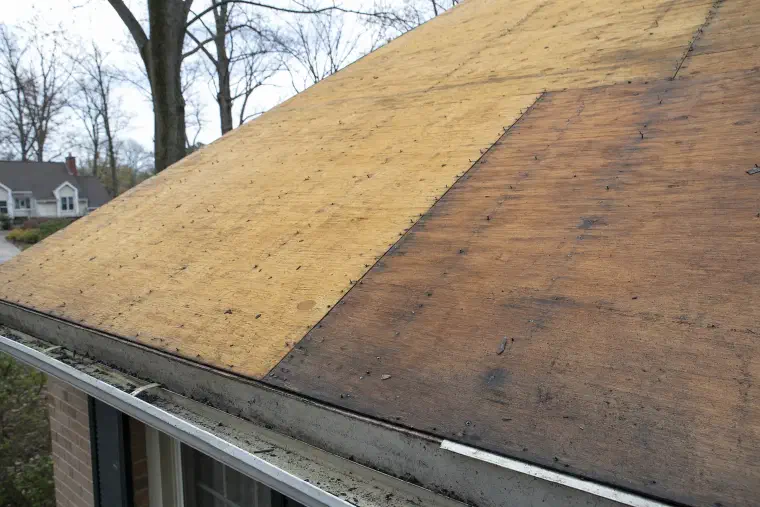
Roof decking is the layer of wood under your shingles. It is nailed across the rafters, and everything else on the roof is fastened to it. Sheathing is another name for it, and you will hear both from roofers.
The short version
- Decking is the wood sheet (or board) layer between the rafters and the roofing.
- Most houses have plywood or oriented strand board. Some older ones have boards.
- It holds the nails, carries the weight and keeps the shingles flat.
- It rots from the underside as often as from a leak above.
- You usually see it for the first time on tear-off day, so ask how a bad sheet is priced.
Where does decking sit on a roof?
Decking sits on top of the rafters (or trusses) and under the underlayment. From the attic it is the underside of the roof you see between the framing. From the street, it is hidden under everything else.
| Layer, top to bottom | What it does |
|---|---|
| Shingles | Shed the water |
| Underlayment | A backup water layer |
| Decking | Holds the nails and the weight |
| Rafters or trusses | The frame that carries the roof |
| Attic air space | Lets the deck dry out |
Our article on what roof underlayment does covers the layer right above it. The Asphalt Roofing Manufacturers Association says shingles should not go straight onto a wood deck (opens in a new tab), and that underlayment is there to shield the deck from wind-driven rain.
Is roof decking the same as sheathing?
Yes. Decking, sheathing and “the deck” all mean the same wood layer. The word “deck” has nothing to do with the patio out back. It is the flat working surface of the roof.
You may also hear “substrate”, which is the formal word for whatever the shingles go on. It is the same layer again.
What is roof decking made of?
Mostly plywood or oriented strand board, a panel pressed from wood strands. According to This Old House, the sheathing is usually plywood or OSB (opens in a new tab), and older houses may have tongue-and-groove or narrow skip sheathing boards instead.
Older Howard County houses are a good place to find those boards. They are narrow planks with small gaps between them, and they behave differently from big sheets. Nails can split a dry old board, and a rotted one can look fine until you press on it.
For the plywood versus OSB question, we wrote a separate piece on which decking is better.
What does decking do for the roof?
Three jobs. It carries the load, it gives the nails something solid to bite into, and it keeps the roof surface flat.
The nails matter most. A shingle held by a nail that misses the deck is held by its sealant strip alone. The Insurance Institute for Business and Home Safety recommends decking that is at least 7/16 inch thick (opens in a new tab) and fastened with ring-shank nails, closer together near the edges. That is a high-wind recommendation, but it shows how much of the roof’s strength is in the deck and how it is nailed.
A flat deck matters for looks too. The manufacturers’ association notes that underlayment helps reduce picture framing (opens in a new tab), the visible outline of deck panels you sometimes see through new shingles.
How does decking go bad?
Water that stays. It gets there two ways, and the second one surprises people.
From above, a failed flashing, a cracked pipe boot or an overflowing gutter wets the deck. A ceiling stain is the last stage of that, so the wood has often been damp a long time before anyone sees it inside.
From below, warm, humid air from the house leaks into the attic and lands on the cold underside of the deck. The PNNL guide on cold-weather attics says that air condenses on the underside of the roof sheathing (opens in a new tab), and often as frost when it is cold. Repeated condensation can cause rot, swelling and delamination (layers peeling apart) in wood panels.
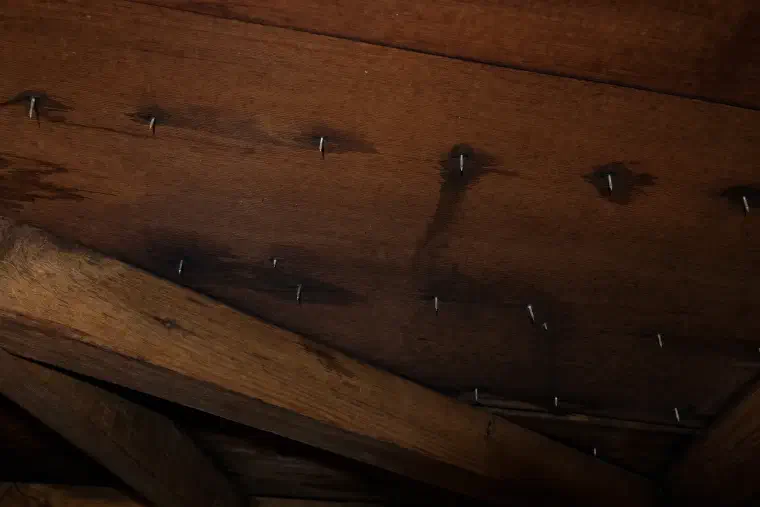
We see the same few causes again and again: bath fans or dryer vents that end in the attic, gaps around can lights and the attic hatch, and an attic with no air coming in at the eaves. A deck can be ruined without a single drop coming through the shingles. Our article on why attic ventilation matters explains how airflow keeps it dry.
How can you tell if your decking is bad?
Look from the attic first. You can check most of the signs from there with a flashlight.
- Dark stains or black spots on the underside of the wood, especially around nail tips
- Frost on the underside on a cold morning (winter is the best time to look)
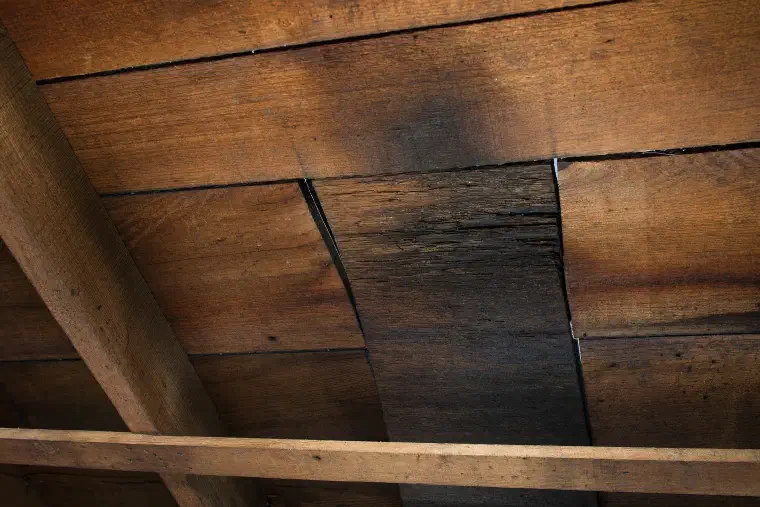
- Wood that feels soft, spongy or flaky when you press it with a screwdriver tip
- Panels that look swollen or have layers peeling at the edges
- Daylight showing through, or boards that have pulled apart
From outside, the signs are weaker. A sag between rafters, a spongy spot when someone walks the roof, or shingles that ripple in a pattern can all point at the deck. A roof with no signs outside can still have a bad deck.
We do not recommend you climb the roof to test it. The attic check is safer, and a free roof inspection includes a walk on the roof and a look in the attic when it is safe and accessible. It is a snapshot, not a guarantee.
What happens to decking when you get a new roof?
The old shingles come off, and the wood gets looked at for the first time. Any sheet that is wet, soft or damaged gets replaced. The ones that are sound stay.
Decking replacement is not in the base price of our roof installation. It is priced per 4x8 sheet, and a replaced sheet typically runs $70 to $150 installed. On a repair, decking found wet under the patch typically adds $150 to $500 or more, and a decking section plus new shingles typically runs $1,500 to $5,000.
Replacing a bad sheet is not optional, and that is the point of the tear-off. A second layer of shingles over the old roof hides the deck and traps heat, so nobody can see what is underneath. Our roof installation page lists what a full replacement includes.
Common questions
Can you shingle over bad decking?
No. A soft or wet deck cannot hold nails, and covering it just hides the problem. Bad sheets get cut out and replaced first.
How long does roof decking last?
Usually longer than the shingles, as long as it stays dry. It fails early when moisture sits on it, from a leak above or condensation below.
Is a sagging roof always a decking problem?
Not always. A sag can come from the deck, the rafters or the trusses. Framing problems found after tear-off can need an engineer’s letter, which typically runs $600 to $1,500, so it is worth having someone look before you guess.
What to do next
If you are about to replace your roof, ask how bad decking is priced before the tear-off, and ask to see photos of any sheet that gets swapped. The page above lays out what is and is not in a replacement.


