

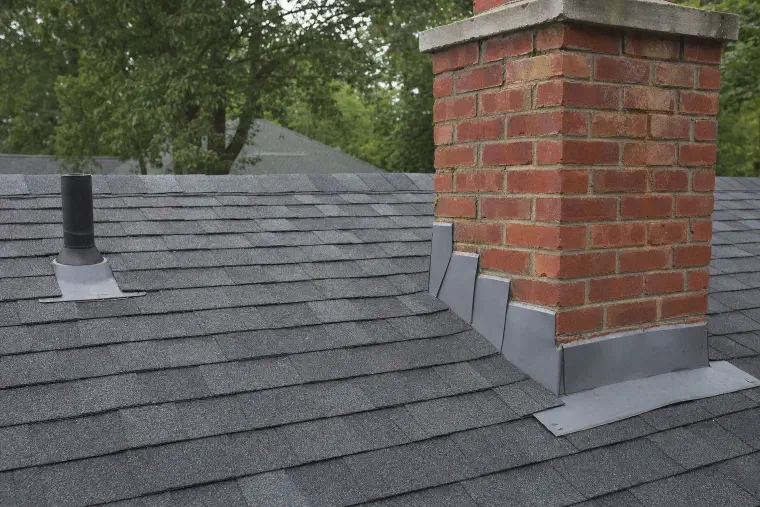
Roof flashing is thin metal, bent to shape, that seals the spots where a roof is cut or joined. Shingles shed rain on an open slope. Around a chimney, a pipe or a wall, the metal does the sealing, and your roof leaks if it fails.
The short version
- Flashing is the metal at the joints of your roof: chimneys, vents, walls, skylights and valleys.
- Shingles keep water off the open slope. Flashing keeps it out of the gaps.
- Metal flashing usually outlasts the roof only if it is new. Reused flashing is a common shortcut.
- Caulk is not flashing. It wears out in 5 to 10 years.
- Most flashing repairs are small, and they are far cheaper than fixing a ceiling and the wood above it.
What does roof flashing do?
It stops water getting in at the places shingles can’t cover on their own. Roof flashing (opens in a new tab) is a thin strip of sheet metal or plastic installed around the edges of roof features, according to This Old House. Think of it as a collar or a gutter, sized for one spot.
A roof is a lot of overlapping layers. Every layer sheds water onto the one below it. A joint breaks that pattern, because water has to turn a corner there. Flashing gives it a path over the top.
Where is flashing on a roof?
Anywhere something sticks up through the roof or runs into it. Skylights, chimneys, vents and any other protruding features (opens in a new tab) all need flashing, and so do the low points where two slopes meet.
| Spot | What the flashing is called | What it does |
|---|---|---|
| Where a roof meets a side wall | Step flashing | Bent pieces, one per row of shingles, that climb the wall |
| Bottom of that wall run | Kickout flashing | Throws water into the gutter |
| Around a chimney | Base, step and counter flashing | Seals all four sides of the brick |
| Around a pipe or vent | Pipe boot or collar | Fits over the pipe and under the shingles |
| Where two slopes meet | Valley flashing | Carries a lot of water down the middle |
| Around a skylight | Skylight flashing | Seals the frame to the roof |
We’ve written a separate piece on step flashing, if you want the detail on the most common one.
How does flashing work around a chimney?
It takes three parts. The Building America Solution Center says the metal at a chimney consists of three elements (opens in a new tab): a base flashing, a step flashing and a counterflashing. The base goes across the low side, the step pieces run up the sides, and the counterflashing laps over the top of the others.
That is why a chimney leak is rarely the bricks. The metal is where it fails, and the fix is the metal.
What is flashing made of?
Mostly galvanized steel. This Old House calls it the most common roof flashing material (opens in a new tab), with aluminum, copper and lead also in use. It says aluminum and galvanized steel last 20 to 40 years (opens in a new tab), and copper can last 100 years or longer.
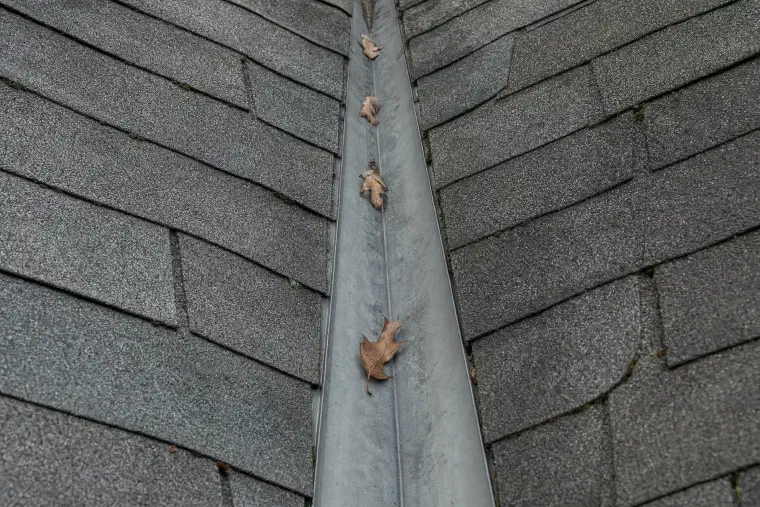
The metal is rarely what gives out first. Most shingle roofs in our area last 18 to 25 years, so flashing that goes in with the roof should last as long as it does. The trouble starts when it is reused from an older roof, cut too short, or replaced with a bead of caulk.
Why does flashing fail?
Almost always because of how it was put in, not because of the weather. We see the same few shortcuts again and again:
- Caulk instead of metal. Sealant is a consumable with a 5 to 10 year life. Any detail that depends on it is a leak with a date on it.
- Old flashing put back. Cheap bids often reuse the chimney, step and kickout flashing from the old roof. It is the one part that leaks, and it ends up the oldest part of a new roof.
- A missing piece. No kickout at the bottom of a wall, or no valley metal, leaves a gap that only shows up in heavy rain.
- Cheap pipe boots. A rubber collar around a vent pipe tends to crack in 3 to 5 years.
The annoying part is how quiet it is. Water runs down inside a wall or along the wood for years before a stain shows on the ceiling. The Building America Solution Center says missing kick-out and step flashing has caused thousands of dollars worth of damage (opens in a new tab) for homeowners.
How can you tell if your flashing is failing?
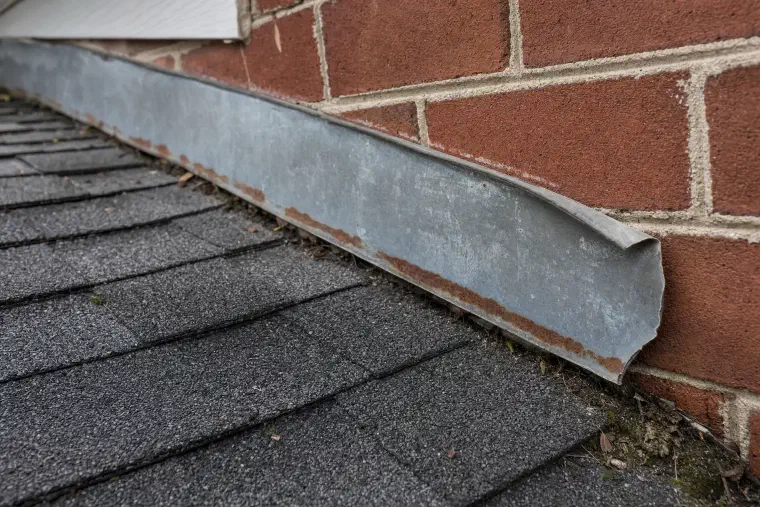
Start from the ground and look for the clues. The Building America Solution Center lists streaks of discoloration, mold, or algae (opens in a new tab) along walls below a roof joint as signs of trouble. Inside, look for:
- a ceiling stain near a chimney, a wall or a vent
- a leak that only shows up in wind-driven rain
- thick gray caulk where the roof meets brick or siding
- rust streaks, curled corners or metal pulling away from the wall
Most of it can’t be seen from the yard, and the pieces are tucked under the shingles. Please stay off the roof. A ladder and a pair of binoculars will tell you more than a trip up there.
What does it cost to fix flashing?
It depends on which piece, and these are typical ranges for the area. A pipe boot typically runs $350 to $750. Step flashing typically runs $700 to $1,900, a chimney reflash $800 to $2,200 and a skylight reflash $900 to $2,000. If the wood under the metal is wet or soft, decking is extra.
Our roof flashing repair page explains how we do the work.
Common questions
Is flashing the same as drip edge?
No, though both are metal. Flashing seals joints and penetrations in the middle of the roof. Drip edge runs along the roof’s edge and sends water into the gutter. Our guide to drip edge covers it.
Can I seal flashing with caulk?
Caulk can buy a season or two, and then it cracks and lets water behind it. The fix that lasts is metal that overlaps the shingles. The Building America Solution Center says flashing should overlap and shed water in shingle fashion (opens in a new tab).
Does a new roof come with new flashing?
It should. Our roof replacements include new flashing at chimneys, walls, valleys, skylights and penetrations unless the quote says it is being reused. Ask to see that line in writing.
Is a valley the same as flashing?
A valley is the shape where two slopes meet. Flashing is the metal that can line it. Our piece on the roof valley shows the difference.
What to do next
If you’ve got a stain near a chimney, a wall or a vent, have it looked at before the wood behind it goes soft. A free roof inspection from us includes a walk on the roof and a look at every joint, and a repair can often be one piece of metal rather than a whole roof.


