

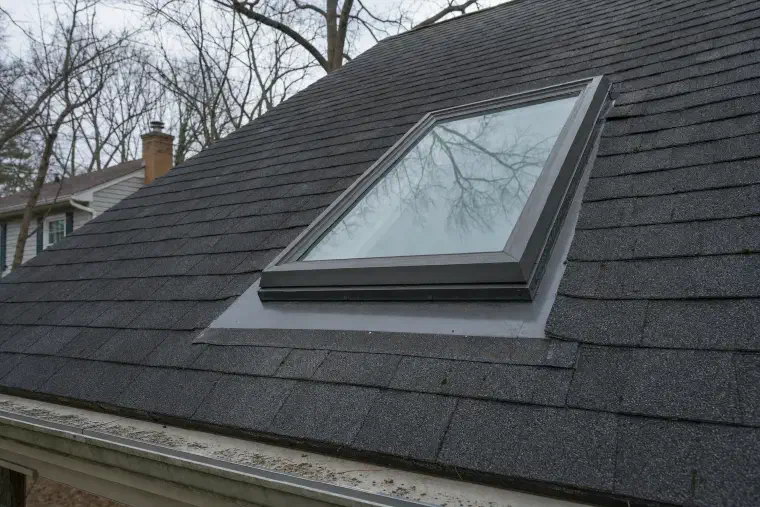
Skylight flashing is the set of bent metal pieces that seal the gap between a skylight and your roof. Shingles shed water on the open slope. Around the frame, the flashing does the job, so when it fails the skylight leaks even though the glass is fine.
The short version
- Skylight flashing is metal that wraps the frame on all four sides and tucks under the shingles.
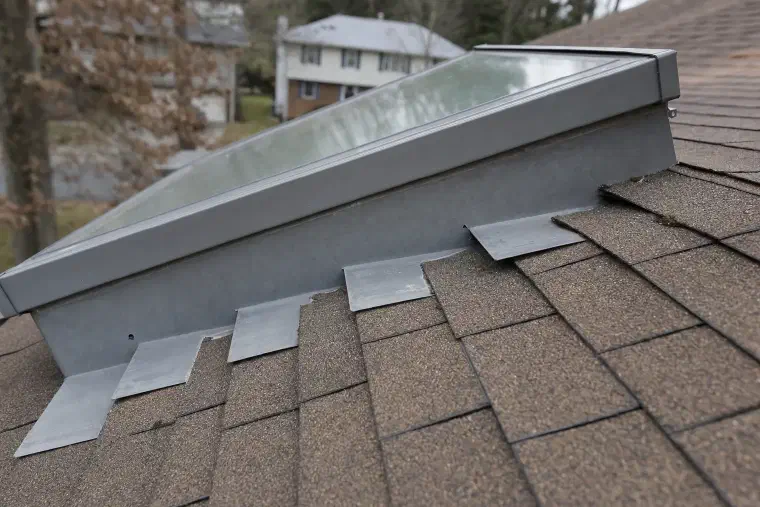
- A full set has four parts: a sill at the bottom, step pieces up the sides, counterflashing over those, and a saddle across the top.
- Most leaks at a skylight come from worn flashing or dried-out sealant, not from the glass.
- A reflash, which means new flashing on the same skylight, typically runs $900 to $2,000.
- Caulk alone is not flashing. It is a patch with a 5 to 10 year life.
What does skylight flashing do?
It gives water a path over the edge of the skylight instead of into the gap beside it. A skylight is a hole cut in your roof with a window set into it. Every side of that hole has to shed water, and the metal is what makes that work.
The Department of Energy puts it bluntly: skylights represent a weak spot (opens in a new tab) in the roof’s water management protection system. That is why a roof can be in good shape and still drip at the one window in it.
Our page on roof flashing covers the metal at chimneys, walls and valleys. A skylight is the same idea with four sides to seal at once.
What are the four parts of skylight flashing?
A full kit has four pieces, and each one covers a different side. This Old House tells installers to make sure the kit includes all four (opens in a new tab): step flashing, counterflashing, saddle flashing and a U-shaped sill flashing.
| Part | Where it sits | What it does |
|---|---|---|
| Sill flashing | Bottom edge of the skylight | Stops water seeping under the front of the frame |
| Step flashing | Up both sides | Small bent pieces, one per row of shingles |
| Counterflashing | Over the step pieces, against the frame | A final barrier if water gets past the steps |
| Saddle flashing | Across the top | Sends water around the skylight so it can’t pool behind it |
The sill matters most. This Old House calls the bottom of the opening often the most vulnerable area for leaks (opens in a new tab), because water runs straight down the roof into it.
How is skylight flashing put in?
It goes in from the bottom up, woven into the shingles. The sill piece goes first, over a course of shingles. The side pieces then go on one at a time, alternating layers of flashing and shingles (opens in a new tab) so each piece is covered by the shingle above it.
The saddle goes last. The installer lifts the first course of shingles above the skylight, slips the top edge of the saddle under, nails it at the top corners and covers it with a final course of shingles.
Notice what that means. Water only ever runs over the top of a piece and never under it. Each layer overlaps the one below, the way the shingles do. Flashing that is only nailed flat and covered in sealant has no overlap, and sooner or later it leaks.
Why does skylight flashing leak?
Usually because the sealant gave out, a piece lifted, or the metal was reused or put in wrong. Those are the usual three:
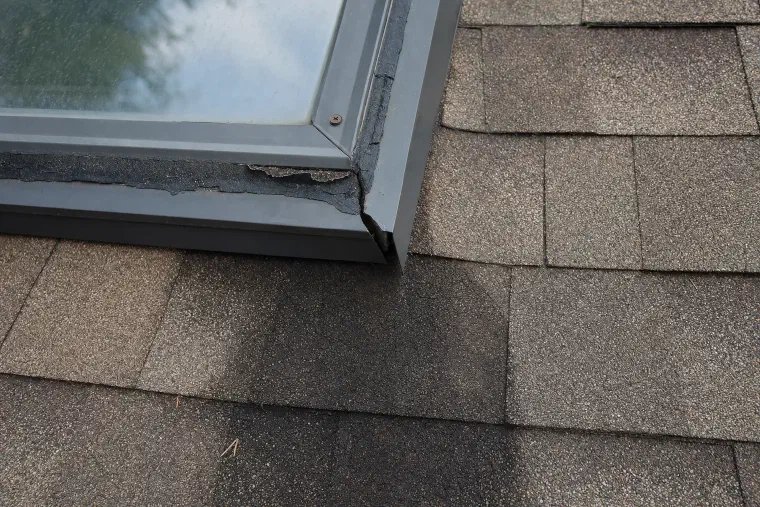
- Dried-out sealant. Caulk is a consumable. Any flashing detail that depends on it to keep water out is a scheduled leak, with a life of about 5 to 10 years.
- Lifted or loose step pieces. A piece that has pulled out of line lets water run behind it.
- Reused or missing pieces. On a reroof, a cheap bid will often keep the old flashing. New flashing at skylights is part of what we put in on a roof installation, unless it is specified as a reuse.
This Old House says to inspect the flashing around a skylight at least twice a year (opens in a new tab) and look for cracked or dried-out sealant, lifted step flashing, or gaps where the curb meets the roof deck.
How can you tell it is the flashing and not the glass?
Look at where the water shows up. A stain on the ceiling along the edge of the skylight well, or a drip that only appears in a hard, wind-driven rain, points at the flashing. Water that runs down the glass is a different problem.
Fog or droplets between the two panes of glass means the sealed glass unit has failed, and flashing will not fix that. Moisture on the room side of the glass is often just indoor humidity. This Old House warns not to overlook condensation as a false alarm (opens in a new tab) for leaks.
If you can see a ceiling stain, keep in mind that it is the last stage. Water has usually been getting in for a while before it shows.
Can you fix skylight flashing with sealant?
Sealant can buy you time, but it does not replace the metal. A fresh bead along a lifted corner might hold for a season. It does not fix a piece that is out of line or a missing saddle.
If the metal is sound and only the sealant failed, resealing can be a small job. If the pieces are bent, rusted or were never layered into the shingles, they need to come out and go back in right.
What does it cost to fix skylight flashing?
A skylight reflash typically runs $900 to $2,000 in our area. That is new flashing around the same skylight. A skylight replacement as a repair typically runs $1,200 to $3,000, so a reflash costs a good deal less when the glass is sound. Our piece on skylight replacement cost goes through when a new unit is worth it.
These are typical ranges, not a quote. The roof pitch, how hard the skylight is to reach and whether the decking underneath got wet all move the number. Wet decking is added at $150 to $500 or more.
Common questions
Does a new skylight come with flashing?
Most come with a matching flashing kit made for that model. This Old House recommends a curbed skylight with the factory flashing kit made for it (opens in a new tab), which it says adds little to the initial cost and helps ensure a leak-free installation. Check that the kit goes with your roofing material, since a shingle roof and a metal roof use different details.
How long does skylight flashing last?
The sealant is the short-lived part, at roughly 5 to 10 years. That is why a skylight that was dry for years can start to drip with no other change.
Can I check it myself?
You can look from the ground or a safe window. We’d keep off the roof. If you see a stain on the ceiling near the skylight, dark streaks below it on the shingles, or black sealant that is cracked or peeling, have it looked at. Our free roof inspection includes a walk on the roof and a look at the flashing, with photos.
Do I need to replace the skylight if the flashing is bad?
Often no. The glass and frame are usually fine, and the leak is in the metal and seal around them. A replacement makes sense when the sealed glass has fogged or the frame joints leak.
What to do next
If your skylight is dripping, don’t assume it has to come out. Our skylight repair work starts with the flashing, because that is where the water is usually getting in. Call us any time, day or night, and tell us what you are seeing.


