

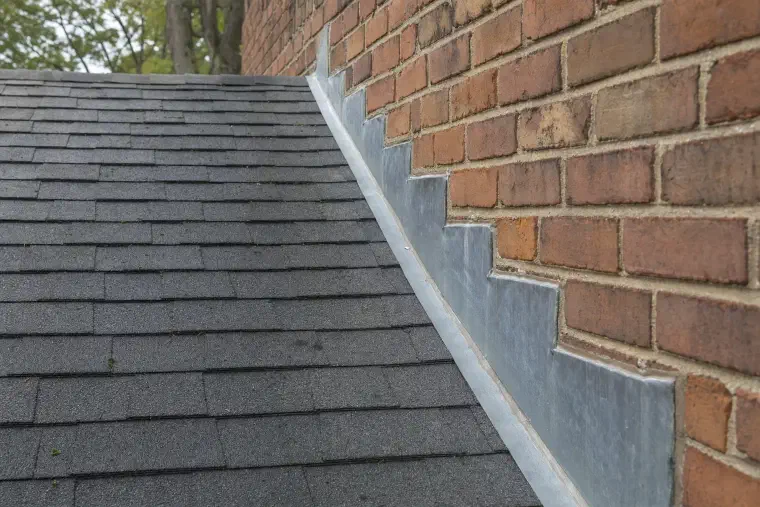
Step flashing is a row of small, bent pieces of metal that seal the spot where a sloped roof runs into a wall. One piece goes in with every row of shingles, so together they climb the wall like a staircase and keep rain from running behind the siding or brick.
The short version
- Step flashing is made of separate L-shaped pieces, one per row of shingles, not one long strip.
- It goes anywhere a roof edge butts against a vertical wall, including dormers and chimney sides.
- A small piece called a kickout flashing finishes the run at the bottom and sends water into the gutter.
- Sealant is not flashing. Caulk wears out in 5 to 10 years, and metal that depends on it fails with it.
- Reused step flashing is a common shortcut on cheap roofs, and you cannot see it from the ground.
What is step flashing?
It is metal bent into an L, with one leg flat under the shingles and one leg pointing up the wall. This Old House describes it as L-shaped pieces (opens in a new tab) where each one goes under the shingles and bends up against the vertical surface.
Flashing in general is the metal that seals the joints on a roof. Shingles shed water on open slopes, but they can’t seal a joint by themselves. Where the roof meets a wall, the metal does the sealing, and the shingles cover it.
How does step flashing work?
Each piece overlaps the one below it, and the shingles overlap the metal, so water always runs downhill over the next layer and never behind it. The Building America Solution Center says to extend step flashing at least 4 inches up the wall (opens in a new tab) from the roof deck and at least 4 inches out along it.
Picture the roof as a set of steps: every row of shingles is one, and the water takes the steps down, passing over each piece of metal on the way.
This Old House is blunt about the install. Step flashing must be installed one piece at a time (opens in a new tab) with each course of shingles, never as a single continuous strip. A long strip can’t tuck under each row, so water finds the seam.
Where does step flashing go?
Anywhere a sloped roof ends against something that goes straight up. That means:
- the side of a dormer
- a roof that runs into the wall of a second story or an addition
- the sides of a chimney, with other flashing across the top and bottom
- the sides of a skylight
It belongs to shingle roofs, since the pieces weave in between the rows.
What is kickout flashing?
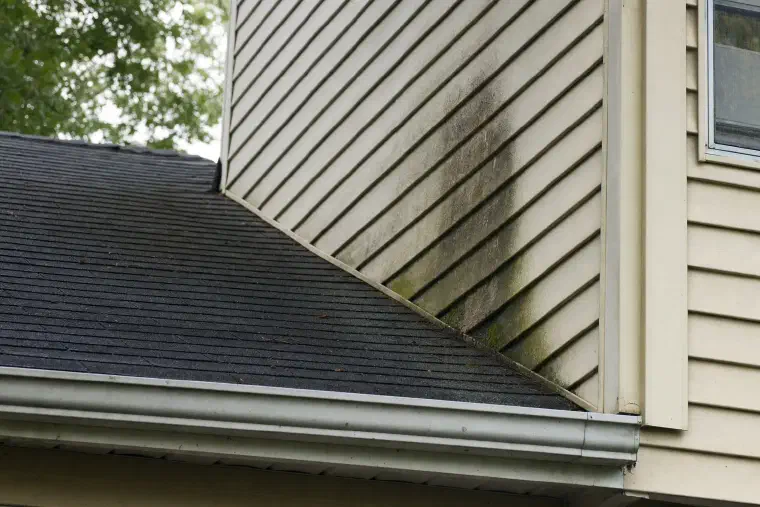
It is the piece at the bottom of a wall run, bent to throw water away from the wall and into the gutter. Without it, all the water that has run down the length of that roof edge hits the end of the wall at once. The Building America Solution Center says to install kick-out flashing (opens in a new tab) at the end of a roof-wall joint to divert water away from the wall and into gutters.
The National Roofing Contractors Association calls the place where gutters meet rising walls an important but often overlooked detail (opens in a new tab). We agree. Missing kickouts are one of the things we find again and again, and the damage is hidden behind the siding. The Building America Solution Center notes that missing kick-out and step flashing has caused thousands of dollars worth of damage (opens in a new tab), including rot and mold inside the wall.
| What you see | What it can mean |
|---|---|
| A dark stain running down siding at the bottom of a roof edge | Missing kickout, water is going behind the wall |
| A ceiling stain on a wall that meets the roof | Failed step flashing along that wall |
| A thick bead of caulk along the wall and shingles | A fix that is hiding a flashing problem |
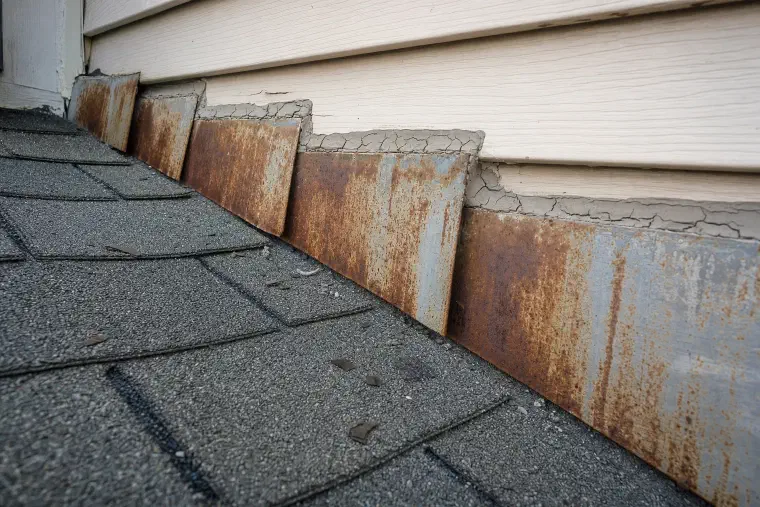
| Rust streaks or lifted metal edges | Old flashing that has reached the end of its life |
Can step flashing be reused?
It can be, and good roofers don’t. On a tear-off, the old pieces are buried under shingles, bent from years in place and often rusted at the edges. Putting them back saves a little time and leaves the one part that leaks as the oldest part of the roof.
Cheap bids often reuse existing chimney, step and kickout flashing. New flashing is what gives a roof its life, which is why our roof replacements include new flashing at chimneys, walls, valleys, skylights and penetrations unless the quote says it is being reused. Ask to see that line in writing.
The metal itself is not the weak point if it’s good. This Old House says aluminum and galvanized steel flashing generally lasts 20 to 40 years (opens in a new tab). Most shingle roofs in our area last 18 to 25 years, so flashing that matches the roof should not need doing twice.
Why does step flashing leak?
Usually because of a shortcut, not because the metal wore out. Three causes come up most:
- Caulk instead of metal. Sealant is a consumable with a 5 to 10 year life. Any detail that leans on it is a leak with a date on it.
- Reused or too-short pieces. A piece that doesn’t reach 4 inches up the wall leaves the gap water likes.
- No kickout. The corner at the bottom of the wall soaks every time it rains.
The annoying part is how quiet it is. Water runs down inside the wall for years, and the first sign can be a stain on a ceiling far from the roof edge.
Common questions
How much does step flashing repair cost?
Step flashing repair typically runs $700 to $1,900, and it’s one of the repairs that makes up most service calls. The price climbs when the wood under the metal is wet or soft, since decking replacement is separate. Our roof flashing repair page covers what the work involves.
Can I caulk the joint instead?
It buys time and hides the problem. Caulk can crack and shrink in 5 to 10 years, and it can trap water behind it once it fails. If a wall joint leaks, the real fix is metal that overlaps properly, and it is worth a look at the whole run, not one spot.
How can I tell if my step flashing is bad?
Look for ceiling stains along a wall, stained siding below a roof edge, rusted or lifted metal, and thick caulk where the roof meets the wall. Most of it is only visible from the roof, and the pieces are hidden under shingles. A free roof inspection from us includes a walk on the roof and a look at every wall joint.
Is step flashing the same as counterflashing?
No. Step flashing is under the shingles at the sloped sides of a wall or chimney. Counterflashing is a second piece set into the wall or cut into the brick that laps over the top. A chimney usually has both. We explain the other roof problems we see most in our article on the five most common roofing problems.
What to do next
If you’ve got a stain near a wall, or the flashing looks old and caulked, have it checked before the wood behind it goes soft. We can find which pieces are bad and replace only those. A gutter that overflows at that same wall is worth a look too, since a full one can rot the board behind it, as we explain in why a fascia board rots.


