

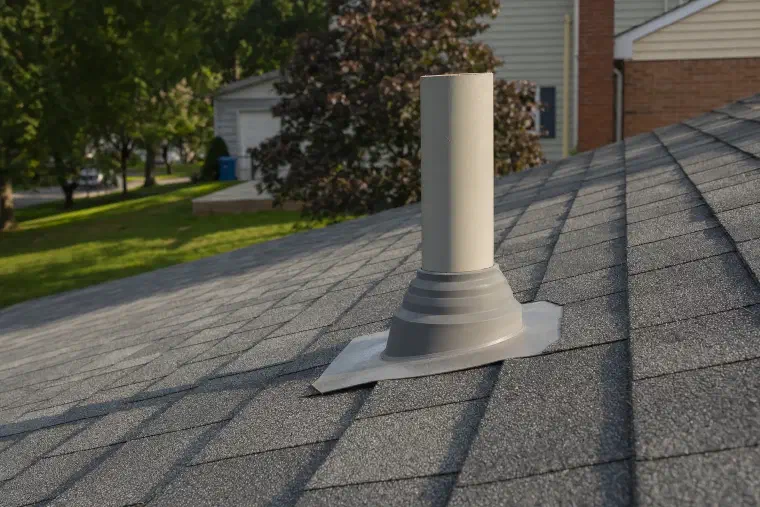
The best pipe boot for a roof is one that does not rely on a rubber ring to keep water out. Silicone and lead boots outlast a cheap rubber collar by years. Rubber is fine if it is all you can get, but plan on swapping it.
The short version
- A pipe boot is the collar that seals the gap where a vent pipe comes through the roof.
- Plain rubber boots are cheap and crack first, often in 3 to 5 years in our experience.
- Silicone collars and lead boots are the better pick for a roof you want to leave alone.
- The boot itself costs little. The trip to the roof is most of the bill.
- Caulk on a cracked boot buys you a few years at best.
What does a pipe boot do?
A pipe boot seals the hole where a plumbing vent pipe goes through your roof. It has a flat base that sits under the shingles and a collar that hugs the pipe. The trade word is flashing, which just means a piece that keeps water from getting behind the roofing.
A federal building science guide says pipes and vents through the roof should be flashed with boot or collar flashing (opens in a new tab). It also says the flashing has to overlap and integrate with the shingles (opens in a new tab) as if it were a shingle itself.
Which pipe boot lasts longest?
Lead and silicone last longest, and plain rubber lasts the shortest time. The weak spot in a standard boot is the rubber ring around the pipe. Sun and weather wear it down. This Old House puts the breakdown at about 12 years (opens in a new tab) of sunlight and weather before the rubber cracks and lets water in.
We see it go faster than that. Cheap rubber collars tend to crack in 3 to 5 years, where a silicone or lead boot holds up far longer. Where you land depends on the product and how much sun the pipe sees.
| Boot type | What to expect |
|---|---|
| Rubber collar on a metal base | Cheapest. The ring is the part that cracks. |
| Silicone collar | Stays flexible in the sun. Our pick for most roofs. |
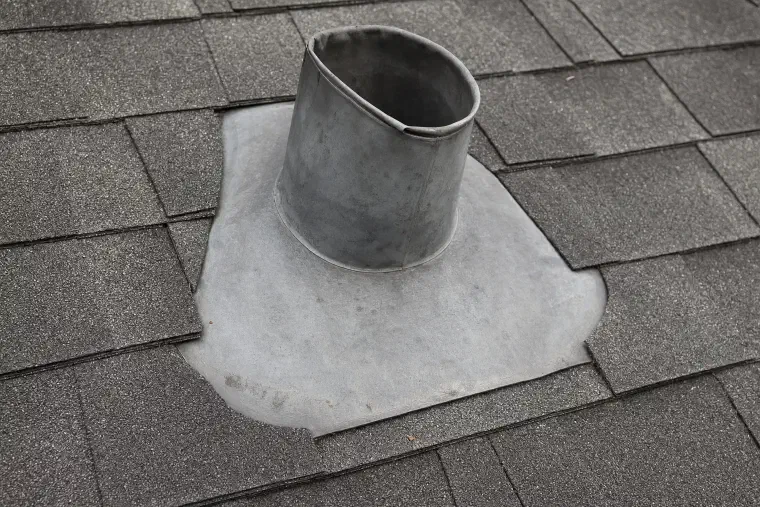
| Lead | A soft metal that folds into the pipe. No ring to crack. |
Is a lead pipe boot better than rubber?
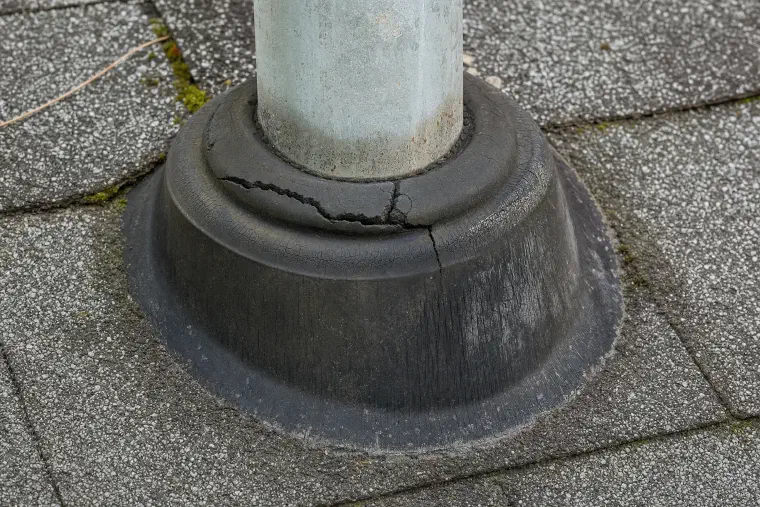
For lasting, yes. Lead has no rubber ring to dry out, so there is no part that splits in the sun. The soft metal bends to the shape of the pipe and the shingles.
The trade-off is that lead costs more up front and takes a bit more care to fit. If a roof has plenty of life left, a silicone boot is often enough. If you want to touch that pipe once and forget it, lead is the one.
How do you know your boot is failing?
Look for cracks, gaps or a split in the rubber. This Old House says to look for wear, cracking or separation (opens in a new tab) in the caulk or rubber boots. Inside, the signs are damp or moldy attic insulation, drips in the attic during rain, or a water stain on a nearby ceiling.
A boot can also fail the day it goes in. Tom Silva of This Old House notes that if the rubber is pushed down on a pipe with a sharp edge, it can tear (opens in a new tab). Keep in mind that a stain on the ceiling is usually the last stage of a leak, not the first.
Can you just caulk a cracked boot?
You can, and it will hold for a while. But caulk is a consumable with a life of about 5 to 10 years, and any detail that depends on sealant to keep water out is a scheduled leak. We think of caulk as a patch, not a fix.
A new boot is the real answer. If the metal base is still sound, This Old House says it may be possible to replace just the boot (opens in a new tab). Whichever you choose, the new one has to fit snugly and its base has to lie flat against the roof.
What does it cost to replace a pipe boot?
A pipe boot typically runs $350 to $750 to replace around Ellicott City. That sounds like a lot for a part that costs a few dollars. The part is not the cost. Most small repairs land at or near the minimum service call, which typically runs $350 to $550 with an independent roofer and $550 to $900 with a larger company, because getting to the roof is the main cost.
So if one boot is failing, ask about the others. They went on at the same time and are the same age.
Common questions
How many pipe boots does a house have?
Most houses have a few, one for each vent pipe that goes through the roof. They are the black or gray collars you can see from the yard. Bath fans and dryer vents are different parts and use their own flashing.
Can I change a pipe boot myself?
Sometimes, if you are comfortable on a roof and the metal base is in good shape. Going up there is the risky part, and the shingles around it have to be handled carefully. If you are unsure, we would rather you call than climb.
Should I replace the boot when I get a new roof?
Yes. Reusing old flashing is a common shortcut, and a boot that is already 10 years old will not last another roof’s lifetime. A new roof should come with new boots.
What to do next
If you can see a cracked boot, or you have a stain you cannot explain, our Roof Repair service covers swapping the boot. Not sure what is wrong? Our free roof inspection will check every boot on the roof. For more on why the collar is there, read what a pipe boot is, or see why a roof vent leaks.


