

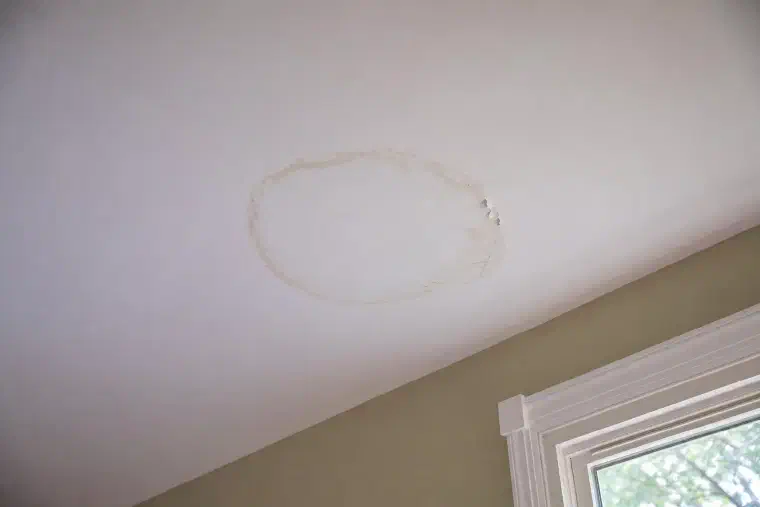
With a leak in the ceiling, catch the water first and find the source second. Move things out from under it, set a bucket below the drip, and stay clear of any wet light fixture. Then get the roof checked, because a stain is usually the last sign of a leak, not the first.
The short version
- Protect people first: stay out from under a bulging ceiling and keep away from wet light fixtures and outlets.
- Catch the water, move the furniture, and take photos of the stain.
- The hole in the roof is rarely right above the stain, so follow the water uphill.
- Wet drywall and insulation need to dry within 24 to 48 hours or mold can start.
- Interior repairs come last, after the roof is fixed.
What should you do in the first ten minutes?
Make the room safe, then slow the damage. Everything else can wait until the water stops being an emergency.
- Check for wiring. If water is dripping from a light fixture or the ceiling around one, turn that room’s power off at the breaker box, not just the wall switch. Leave it off until an electrician says it is fine.
- Move people and things. Clear furniture, rugs and anything that matters from under the spot.
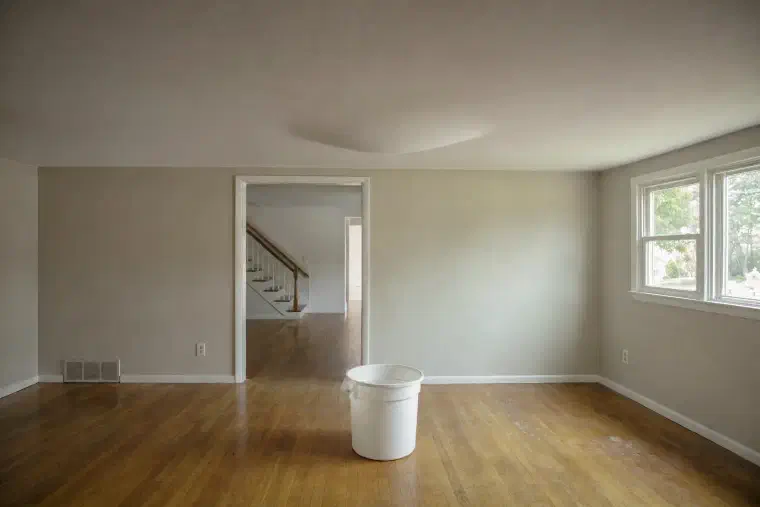
- Catch the drip. Put a bucket under it, and a towel in the bucket so it does not splash.
- Take photos. Take a few of the stain, the drip and the bucket, with the date on your phone. You will want them for the roofer and, if it comes to it, for your insurance company.
- Mark the edge. Draw a pencil line around the stain and write the time beside it. If the ring grows, you can see how fast.
What if the ceiling is bulging or sagging?
A bulge means water has pooled on the other side of the drywall, and it can come down without much warning. Keep people out from under it and put a bucket on the floor beneath.
If it is small and you feel safe, many people poke a small hole at the lowest point so the water drains into the bucket instead of arriving all at once. A big bulge, one near a light fixture, or one you are not sure about is not a do-it-yourself job. Call a roofer and tell them what you see.
Where is a leak in the ceiling really coming from?
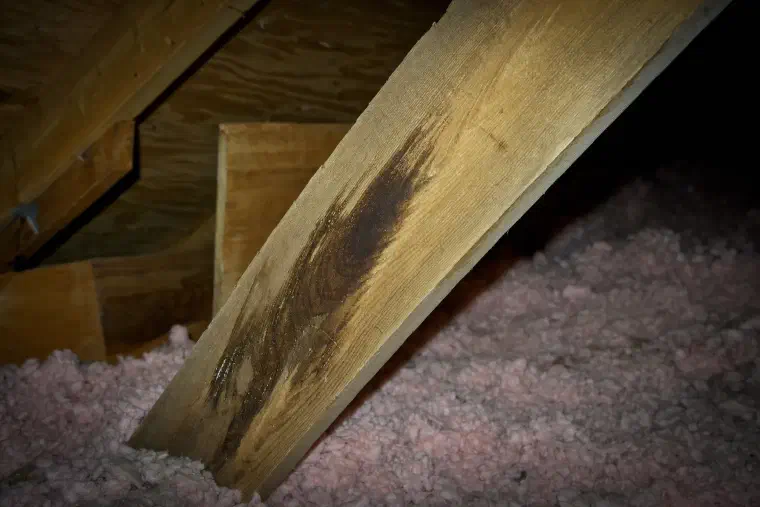
Almost never from the spot directly above the stain. Water gets in at one place, runs down the wood under the shingles, and drips through the ceiling somewhere else. The rule from This Old House is that the leak likely originates higher up (opens in a new tab), so follow any signs of water uphill.
If you can get into the attic safely, take a flashlight and look above the stain. You are looking for water stains, dark spots, mold growth, or trails of moisture along the rafters (opens in a new tab) and roof sheathing, which is the plywood under the shingles. Damp or squashed insulation is a clue too.
Not every ceiling leak comes from the roof. Here is what to rule out:
| What you see | What it often is |
|---|---|
| Stain that shows up only after rain or wind | Flashing, a cracked pipe boot or a worn seal on the roof |
| Stain that grows after cold nights, with no rain | Moist house air condensing in the attic |
| Stain under a bathroom or near an air handler | A plumbing or air conditioner drain line |
| Stain below a chimney or skylight | The flashing around it, or the unit itself |
Rain that only gets in when the wind blows from one side usually points to a flashing gap. We cover that in why a roof leaks after the rain stops. If the stain is small and has not changed, what counts as a minor roof leak helps you judge how fast to move.
One thing to keep in mind: the stain you see is the last stage. Water has often been getting in for a while, wetting the decking and insulation before it ever shows on the ceiling. No stain does not mean no leak either.
How fast does a wet ceiling need to dry?
Within 24 to 48 hours. The EPA says it is important to dry water-damaged areas and items (opens in a new tab) within 24 to 48 hours to prevent mold growth. Open windows, run a fan toward the spot, and use a dehumidifier if you have one.
Soaked insulation holds water against the drywall, so it often needs to come out. The EPA also notes that absorbent or porous materials, such as ceiling tiles and carpet, may have to be thrown away (opens in a new tab) if they become moldy. It puts the do-it-yourself limit at a moldy patch of about 10 square feet.
If you already see dark spots or smell something musty, our piece on mold from a leaking roof covers what it means.
What does it cost to fix?
Costs here are typical area ranges, not a quote. A roofer’s minimum service call typically runs $350 to $550 for an independent and $550 to $900 for a larger company. A single leak diagnosis and repair usually lands between $500 and $1,600.
Tracing a leak that will not show itself, with a hose test or moisture meter, is its own service and typically costs $150 to $400, and some roofers credit it toward the repair. If the roof has to be covered the same night, emergency tarping typically runs $350 to $900. If the decking underneath turns out to be wet, expect $150 to $500 or more on top.
Two things surprise people. Drywall, paint and insulation inside the house are never part of a roof repair. And no honest roofer can promise a leak will stop on the first visit, because finding the source is partly detective work and a second visit is sometimes needed.
Will homeowners insurance pay for it?
Maybe, and your policy and the adjuster decide, not us and not this article. What caused the leak matters to them, so keep your photos and any repair notes. Call your insurance company, show them your photos, and ask what your policy says before you spend money on anything big.
Common questions
Should I put a tarp on the roof myself?
No. A wet roof is slippery and a fall from a ladder is a far worse problem than a ceiling stain. If the water is coming in fast, an emergency crew can cover the spot until a real fix is possible. Our phone is answered around the clock.
Can I just paint over the stain?
Not yet. Paint over a damp ceiling traps the moisture and the stain bleeds back through. Fix the roof, let the area dry fully, then prime with a stain-blocking primer and paint.
Is a leak in the ceiling an emergency if it only drips in heavy rain?
It is not an emergency, but it is not minor either. A leak that only shows up in hard or wind-driven rain still wets the wood each time, and it does not fix itself. Get it looked at before the next big storm.
What to do next
Once the room is safe and the water is caught, the next move is finding the entry point. Our roof repair crew traces the leak and fixes it in place, usually in one to four hours on the roof. If you are not sure whether it is a repair or something bigger, a free roof inspection puts someone on the roof and in the attic with a written report, and there is no obligation to book work.


