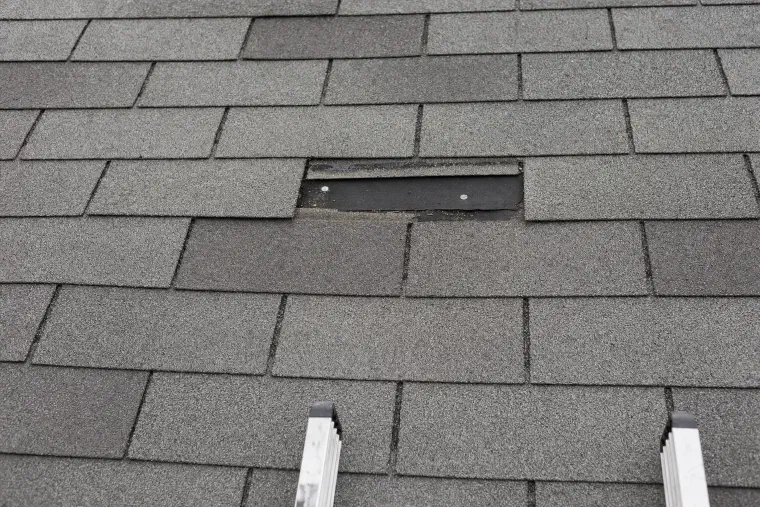
If shingles are missing from your roof, cover the gap quickly and get it fixed soon. A missing shingle leaves the layer underneath open to sun and rain, and that layer was never meant to be the roof. A small repair now is usually cheap. Waiting is not.
The short version
- Look from the ground first. Stay off a wet or windy roof, and take photos of every gap.
- A tarp is a short-term cover, not a repair. Federal guidance puts a temporary roof cover at about 30 days (opens in a new tab).
- Replacing one to three shingles typically runs $300 to $650 in our area.
- Many missing shingles at once, or a roof with brittle shingles, points to a bigger problem than the gap itself.
Can missing shingles cause a leak?
Yes, though not always right away. Under the shingles sits a layer of felt or synthetic underlayment, and under that is the wood deck. Underlayment sheds water for a while, but it breaks down in the sun and it is not built to take weather on its own. A gap over a seam or a nail line is the likeliest spot for water to find its way in.
The annoying part is that the leak shows up late. A ceiling stain is the last stage, not the first. Water has usually been getting in for a while, wetting the deck and the insulation before anything shows inside. No stain does not mean no leak.
What should you do first?
Check the damage from the ground, take photos and call your insurer if a storm caused it. Binoculars help. Count the gaps and note where they are: along an edge, at the ridge, or out in the middle of a slope.
Maryland’s insurance regulator tells homeowners to take photographs and/or video of the damaged areas (opens in a new tab) and to contact the insurer right away. It also says to make only the repairs needed to prevent any further damage (opens in a new tab) and to keep all receipts for emergency work. Your policy and the adjuster decide what is covered, so ask before you assume.
Then go inside. Look at the ceiling under the damaged area and in the attic if you can get there safely. A damp spot or a stain tells you water is already in.
How do you cover missing shingles until repair day?
A tarp over the gap is the usual stopgap, and a roofer should put it up if the slope is steep, wet or windy. A tarp is a wind catcher, and a fall costs far more than a roof. Our guide on how to tarp a leaking roof covers the steps and the limits.
Keep in mind that a cover is meant to last weeks, not months. FEMA says a temporary roof cover is designed to last for 30 days (opens in a new tab). If a tarp is the only thing between your attic and the next storm, plan the real repair soon.
The Asphalt Roofing Manufacturers Association says the same about any quick fix: it should not be considered a suitable long-term repair (opens in a new tab).
Emergency tarping typically runs $350 to $900, and it is often billed separately from the repair. Ask whether it gets credited toward the work.
What does it cost to replace missing shingles?
Replacing one to three shingles typically runs $300 to $650 in our area. That is the low end of roof repair, and most small repairs land near the minimum service call because the cost is getting a crew to your house, not the shingles. A minimum call typically runs $350 to $550 with an independent roofer and $550 to $900 with a larger company.
| What you have | What it typically runs |
|---|---|
| One to three missing shingles | $300 to $650 |
| Wind-lifted shingles across a slope | $600 to $1,700 |
| Emergency tarping | $350 to $900 |
| Decking found wet under the gap | $150 to $500+ added |
| Finding a leak’s exact source | $150 to $400 |
Those are area ranges, not a quote. Steep pitch, a wooded lot with hard ladder access and a rush job all push the number up.
Can you replace a missing shingle yourself?
You can on a low, dry, single-story roof if you are steady on a ladder, but most people should not. The job itself is simple. The risk is the roof. This Old House says to secure the new shingles with roofing nails (opens in a new tab) placed where the overlapping shingles will cover them, and to put a small amount of sealant under the tabs so they stick.
That nail spot is where many repairs go wrong. A nail set too high misses the shingle below, and the new one is held by its seal alone. We see this on whole roofs all the time: they look fine until a 50 mph gust peels them off in courses.
Cold matters too. Shingles need warmth to seal, and winter repairs may not bond until spring.
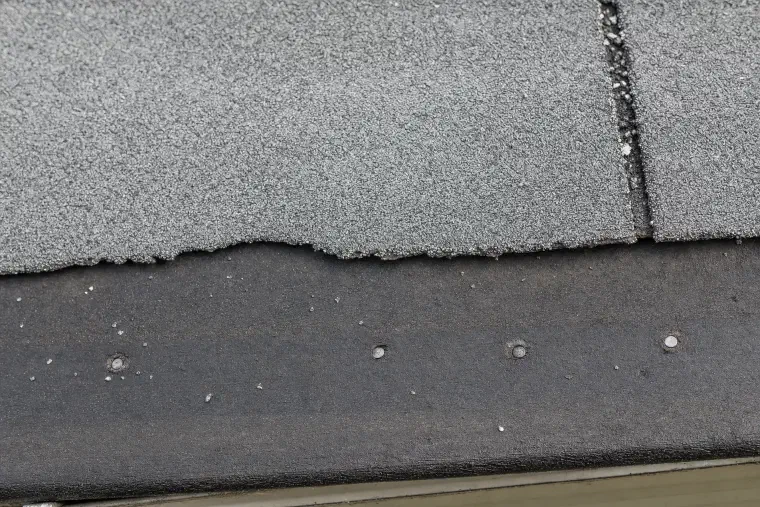
Why will the new shingle look different?
A new shingle rarely matches an old, sun-faded one. Patches are visible, and a discontinued color can force a larger repair or even a whole slope. The best fix is shingles saved from the original install (opens in a new tab), so if you have a few spare bundles in the garage, keep them. If you do not, the color name and the year the roof went on help a roofer find the closest match.
The association adds that a new shingle looks different at first and that this fades as it ages.
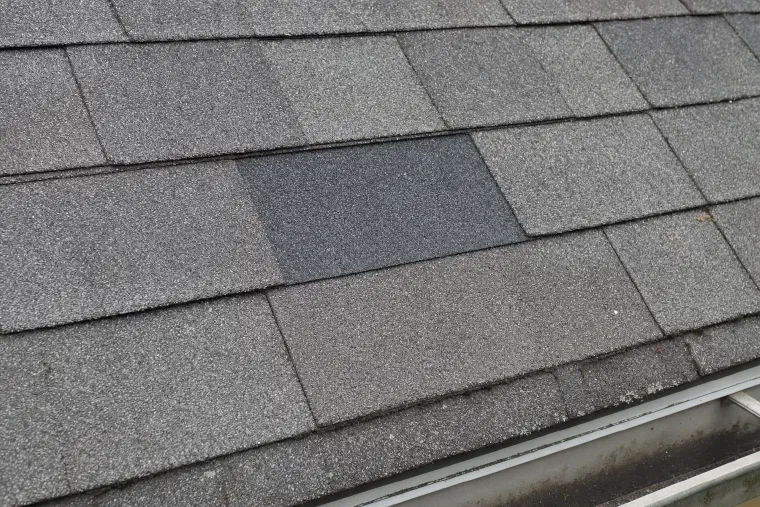
When is a gap a sign of a bigger problem?
When several shingles are gone, or the ones left are brittle. This Old House says to bring in a professional when there are multiple damaged or missing shingles (opens in a new tab), and that if a shingle is brittle or cracking, replacement is usually more reliable (opens in a new tab).
On a roof past 15 or 20 years, a small repair can grow. Old shingles often cannot be lifted without breaking, so fixing one spreads to its neighbors. Repairs on roofs that old typically come with no warranty. On a newer roof, a repair is usually the better buy, and we would rather fix a roof than sell you a new one when a fix will do. Our article on repairing instead of replacing walks through how to decide.
Wind is the common cause. Gusts around 40 mph, repeated over several years, can slowly break the seals until shingles are effectively loose, and then one ordinary windy night finishes the job. Our guide to what wind damage looks like shows the other signs to look for.
Common questions
How fast should missing shingles be fixed?
As soon as you can get a dry day and a roofer. A tarp buys you a few weeks at most. A repair itself takes one to four hours on site, but the wait before it can be done runs one to two weeks in normal conditions and three to six after a big regional storm.
Will insurance pay for missing shingles?
It depends on your policy, the cause and your deductible, and the policy and the adjuster decide. Take photos, keep receipts and call your insurer. We cannot tell you what a claim will pay.
Is it safe to leave one missing shingle?
For a short while, with a cover on it, yes. Left alone, it does not stay one shingle. The exposed felt wears out and the shingles beside the gap are the next to lift. If you are unsure whether it is one gap or the start of many, our article on a roof patch versus a roof repair explains the difference.
What to do next
If shingles are missing and you want to know what is under them, we can look. Our roof repair service starts with a free roof inspection and a walk on the roof, and the phone is answered 24/7.