

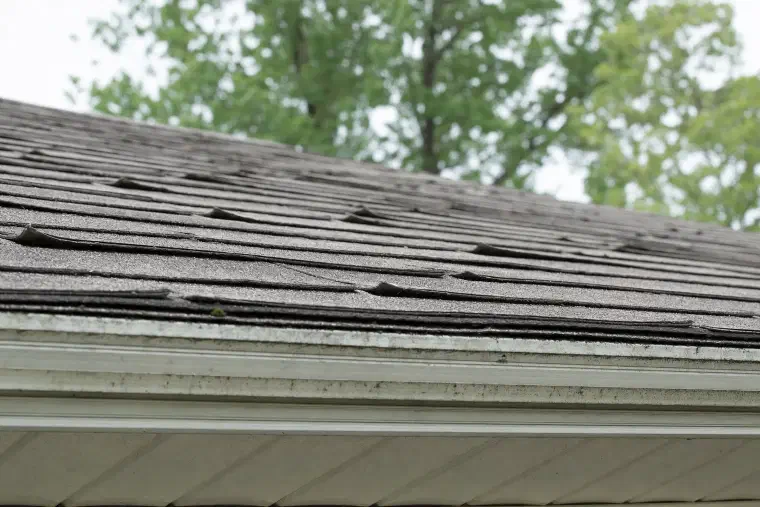
Roof shingles curl because something is making the shingle dry out, shrink or lift at the edges, and the usual culprits are age, a hot or damp attic, nails in the wrong place or a deck that moves. Curling is not a leak yet. It is a warning that the shingle has stopped lying flat and holding on.
The short version
- Curling is most often age, and a roof past its mid-life is allowed a little of it.
- A hot, damp attic bakes shingles from underneath and is the cause we see missed most.
- Nails set too high, or a second layer laid over old shingles, can start it early.
- A shingle that is still soft can be glued down. A brittle one needs replacing.
- Never coat curled shingles with a rejuvenator. The shingle makers’ trade group advises against it.
What does curling look like?
Curling means the edges or corners of a shingle turn up and away from the roof, so the tab no longer lies flat against the one below. You can often see it from the yard as a row of thin shadow lines along each course, and it is easiest to spot in low morning or evening light.
The annoying part is that it creeps. One slope on the sunny side goes first, then the next. By the time the whole roof looks wavy, the shingles have been losing their grip for years. The edges are also what the wind grabs first, so a curled tab is a loose tab.
Why do roof shingles curl?
Shingles curl mostly from age, moisture, heat and poor installation. This Old House says shingles may begin to curl upward at the edges (opens in a new tab) due to aging, moisture, or poor installation, and ties curling and lost granules to heat from long sun exposure.
That list is short, but each item hides a few causes. Age is the plain one. Moisture comes from a damp attic or wet decking. Heat comes from the sun and from an attic with nowhere to send it. Installation covers nails, layers and cold-weather work. The rest of this article takes them one at a time, because the fix is different for each.
Can a hot attic make shingles curl?
Yes. A stuffy attic raises the temperature under the shingles, and shingles that cook from both sides dry out and curl early. The Asphalt Roofing Manufacturers Association explains that in summer, roof deck temperatures can significantly increase (opens in a new tab) from the sun, and the heat from the deck radiates into the attic.
An attic that cannot vent that heat sends it straight back into the underside of the roof. We think this is the most underrated way a roof wears out. It is invisible, it does not feel like damage, and in our experience an unvented attic can cut a roof’s life nearly in half.
The usual faults are easy to describe. A ridge vent was added but the soffits were never cut open, so air has no way in. Insulation blocks the airflow at the eaves. A ridge vent, gable vents and box vents are all mixed together and trade air with each other instead of pulling it through. Bath fans or a dryer vent end in the attic and pump damp air into it. Our attic venting page covers the fixes, and why attic ventilation matters goes into the airflow itself.
Can a damp attic or moving deck cause it?
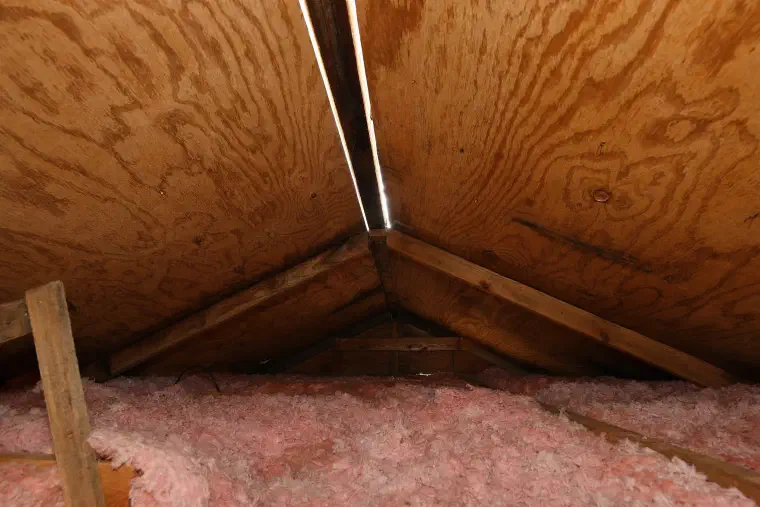
It can. Damp air in the attic soaks the roof boards, the boards swell and shrink, and the shingles above get pushed around. The Asphalt Roofing Manufacturers Association says that lack of attic ventilation, which restricts the free flow of air under the deck, contributes to deck movement (opens in a new tab). That page is about buckled shingles, a close cousin of curling, and it notes that moisture-driven distortion tends to follow the joints in the deck.
Warm, humid air also sneaks up through can lights, bath fans, plumbing pipes and the attic hatch. In winter it condenses on the cold underside of the boards. Frost there on a cold morning is the giveaway, which is why winter is the best time to look in an attic.
Does age cause curling?
Age is the most common reason, and on an older roof a little curling is normal. Asphalt shingles dry out and shrink over the years, and the edges lift first. In Maryland, asphalt shingles realistically last 18 to 25 years, whatever the number on the wrapper says. The reasons the label overpromises are in whether a 30-year shingle lasts 30 years.
Age curling looks even. The whole slope, or the sunniest slope, is turning up at about the same rate. Curling on a young roof is different, and that points at the attic, the nails or the install.
Can bad nailing make shingles curl?
Bad nailing can make a shingle lift, and it is the most expensive fault to find because you cannot see it from the ground. Each shingle has a marked nailing strip. A nail placed above it misses the shingle underneath, so the tab is held only by its sealant strip, and a strip alone does not last.
The same shingle can last 25 years or 9, depending on where the nail went. Too few nails, nails driven so hard they cut the mat and staples cause the same trouble. A second layer laid over old shingles instead of a full tear-off traps heat and hides what is underneath, and a roof put down in cold weather can end up with seal strips that never stuck.
What is my curling pointing at?
The pattern on the roof is the best clue to the cause. This table is a starting point, not a diagnosis, since several causes often overlap.
| What you see | What it usually points to | Who deals with it |
|---|---|---|
| Even curling across a roof past 15 years | Age | A roofer, to judge the roof’s remaining life |
| Curling on a young roof, hot attic, frost in winter | Attic heat or damp | A roofer, to check the vents and airflow |
| Distortion in lines that match the deck seams | Deck moving with moisture | A roofer, after fixing the moisture |
| Curling soon after a new roof, patchy | Nails or install | The installer, or a second opinion |
| Edges lifting after a coating was sprayed on | The coating | A roofer, since it cannot be undone |
Can curled shingles be fixed?
If the shingle is still soft, yes. This Old House describes cleaning the area, putting roofing sealant under the curl, pressing it down and weighting it for at least 24 hours (opens in a new tab). It says that works best when the shingle is intact and flexible, and that for a brittle, badly worn or cracking shingle replacement is usually the better long-term fix.
Cold matters too. The same article notes shingles are easier to work with in moderate temperatures, and ours need more than 40 degrees F to seal. A repair in a freeze may not bond until spring.
Be honest with yourself about the roof, too. Lifting a brittle shingle can crack it, and a small job turns into a bigger one, especially past 15 years. Replacing one to three shingles typically runs $300 to $650, and wind-lifted shingles typically run $600 to $1,700. Patches show, because new shingles never match old ones in color.
Does curling mean I need a new roof?
Not by itself. If the curling is in one spot and the rest of the roof is sound, a repair is usually the better call, and we will tell you so. We would rather fix what needs fixing, or tell you to wait a few years, than sell you a roof you do not need.
Widespread curling on a roof near the end of its life is a different story. Shingles that are curling across every slope are not going to be glued back to health. If the attic caused it, fix the attic when the new roof goes on, or the new shingles will curl too. You can see what roof repair covers or ask for a free roof inspection, where we walk the roof, lift shingles to check the nailing and look in the attic when we can.
Common questions
Can I put a coating on curled shingles?
No. The Asphalt Roofing Manufacturers Association says shrinking coating can lead to curling and cupping (opens in a new tab) and strongly advises against putting any coating or rejuvenator on installed shingles. It also suggests checking with the shingle maker first.
Is roofing tar a good fix?
Not usually. Tar on top of old shingles stops new sealant from bonding, traps moisture and often hides rotted decking underneath. A neat dab of sealant under one tab is fine. A smear of tar across several is a repair someone will have to undo.
Will curled shingles leak?
Not straight away. Curled shingles still shed water for a while, but the lifted edges catch wind, and repeated gusts can break the seal bonds over several years until the shingles are effectively loose. Then water can get under them.
How do I check whether my attic is to blame?
Look in the attic on a cold morning for frost on the underside of the roof boards, and in summer for an attic that feels like an oven. Stay on the hatch ladder or the joists, never step between them. If you would rather not, a free inspection includes the attic when it is safe to get in.
What to do next
Take a photo of the curled spots, note whether they are on one slope or all of them, and check the attic if you can do it safely. Then book the free inspection. We will tell you whether it is the age, the attic or the nails, and whether the answer is a repair or a plan for later. If it is the attic, the fix costs less to do before the next roof than after.


