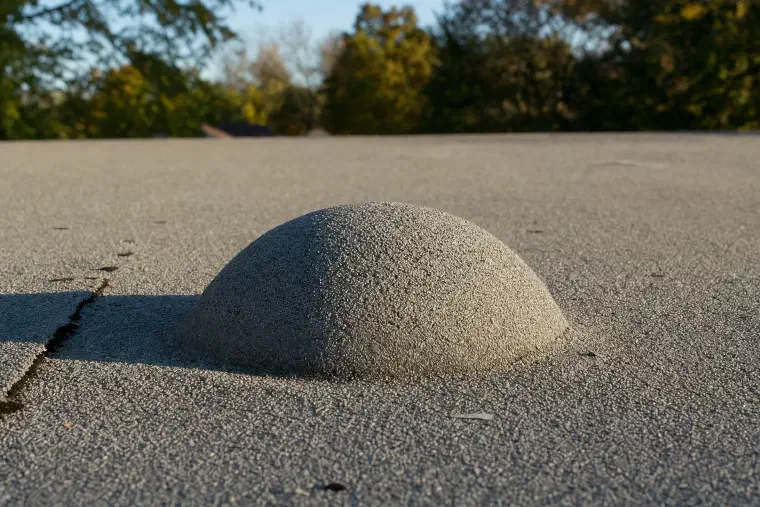
A flat roof blisters when air, water vapor or moisture gets trapped under the surface layer and the sun heats it until it swells into a bubble. The trapped pocket is the cause. The sun is only what makes it show.
The short version
- A blister is a raised bulge in the roof surface with something trapped under it.
- It starts as a gap built into the roof, often from moisture caught in the layers when the roof went on.
- A small, smooth, sealed blister can be left alone and watched.
- A blister that has split, sits on a seam, or comes with a soft spot needs a repair.
- Wet insulation under a blister has to come out, not get covered.
What is a flat roof blister?
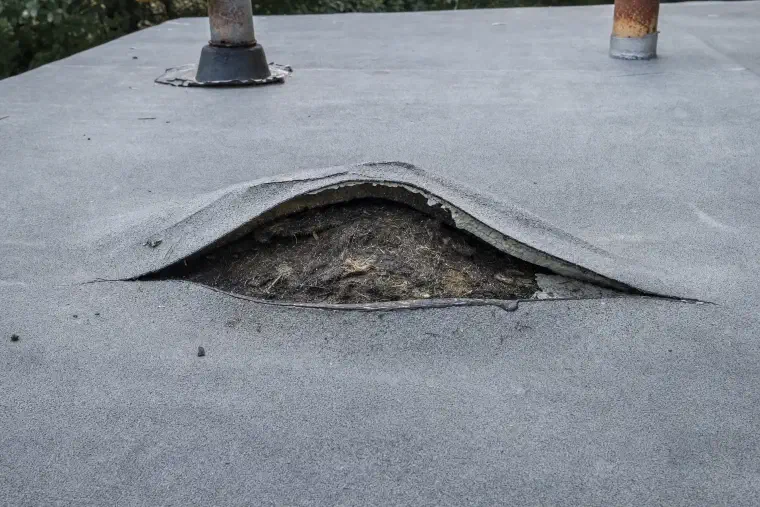
A flat roof blister is a raised bulge in the roof surface, caused by pressure from underneath. The National Roofing Contractors Association defines a blister as a raised portion of a roofing membrane (opens in a new tab) resulting from local internal pressure. A membrane is the waterproof skin of the roof.
Think of a bubble in wallpaper, or a blister on your heel. Something is under there that does not belong, and it pushes the top layer up.
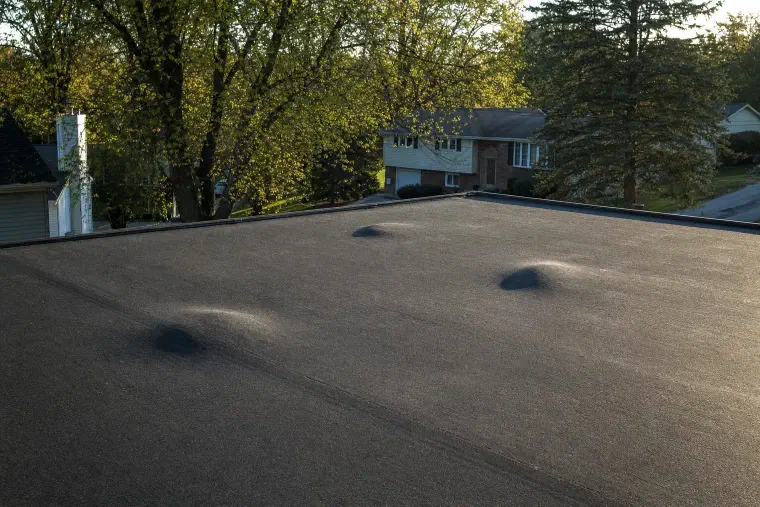
On a flat roof you will usually see a smooth dome, anywhere from the size of a coin to the size of a dinner plate. Press on it and it often gives a little, like a bubble of air under a sticker.
Why does a flat roof blister?
It blisters because a pocket of air or moisture is stuck between layers, and heat makes the pocket take up more room. Warm air and water vapor both expand. If the layer above is stuck down tight everywhere else, the only place for that pressure to go is up.
The pocket is usually built in. These are the usual ways it gets there:
- Moisture was trapped in the roof layers when the roof went on, such as damp insulation or a roof laid in wet weather.
- The layers were not stuck down fully, leaving a gap with air in it.
- Water got in through a small opening later and is now cooking under the surface.
- Dirt or debris was left between layers and kept them from bonding.
Flat roofs show it more than pitched roofs because the whole surface faces the sky. Nothing sheds the heat or the water, and the sun sits right on top of the problem for hours.
Are flat roof blisters a problem?
Not always. A blister is a warning sign, and what it means depends on its shape and what is under it. The ARMA, NRCA and SPRI repair manual for low-slope roofs says that blisters that are keeping air in will keep water out (opens in a new tab), so it may be better to leave a sound one undisturbed.
That manual is written for modified bitumen roofs, a common flat roof material made of sheets of asphalt with plastic or rubber mixed in. We cover it in what modified bitumen roofing is. The same common sense carries over to other flat roof surfaces, but the roof’s own maker or a roofer who has looked at it has the last word.
The same manual lists what turns a blister into a repair job:
- Loss of the gritty surface layer or other signs the membrane is wearing out
- A blister sitting on a seam, where there is less overlap left
- A blister with a break in it that can let water in
- Fine cracks around the edge of the bubble
- A blister in a spot where people walk
The manual says (opens in a new tab) someone familiar with these roofs should decide whether to cut out, patch over or keep watching each blister. That matches how we see it: do not guess from the ground.
How can you tell a harmless blister from a leaking one?
Look at its skin, its location and the roof around it. A harmless blister is smooth, whole and alone. A trouble blister is cracked, wet underneath or surrounded by other signs.
| What you see | What it likely means | What to do |
|---|---|---|
| One or two smooth domes, surface intact | Trapped air, roof still sealed | Mark it, photograph it, check it after each season |
| Dome with a crack or a pinhole | Water can now get in and out | Have it repaired soon |
| Dome right on a seam or at an edge | The weak spot of the roof is now weaker | Have it looked at |
| Soft or spongy feel around it | Wet insulation below | Needs more than a patch |
| Many blisters across the roof | The layers or insulation are failing broadly | Ask about a bigger repair or a new roof |
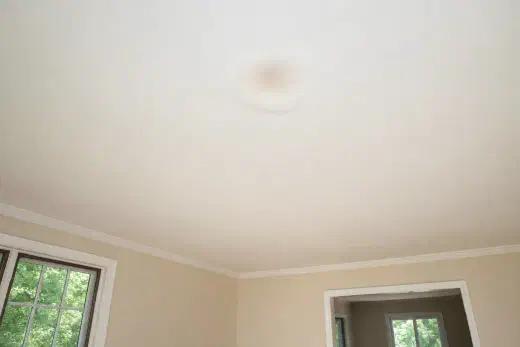
| Water stain on the ceiling below | It is already leaking | Call, and keep buckets handy |
Be gentle checking. Walking on a hot, blistered roof can crack the domes and tear what was sound. Look from a ladder at the edge, or let a roofer walk it.
What does it take to repair a flat roof blister?
A real repair cuts out the blister, finds out whether the layers under it are wet, and patches with new material that sticks down fully. The repair manual lists the steps: cut back the blistered membrane until good adhesion is reached, then inspect the membrane for moisture (opens in a new tab).
If water got in, it says to check the insulation and the deck for damage and to remove wet or damaged insulation, repair or replace the deck where it is damaged, and put in new, dry insulation. After that, the patch is cut from matching material, 8 inches larger than the defect in every direction, with rounded corners so they do not peel.
Notice what is not on the list: slapping tar or sealant over the dome. That seals the trapped moisture in. Our flat roof repair page covers the blisters, leaks and split seams we fix.
On cost, using area ranges and not a quote: a low-slope membrane repair typically runs $2,500 to $6,000. If decking is found wet under the patch, that typically adds $150 to $500 or more. A single small blister patch can sit well under those ranges, so get the size of the problem confirmed before you worry about the number.
Does a coating or a new roof fix blisters?
A coating does not fix a blister. It sits on top of the old surface, so a blister underneath is still a blister. If you are weighing one, read whether a flat roof coating is worth it first.
The Department of Energy says a roof can be in good or moderate condition for a coating, and for one in poor condition near the end of its life it is usually best to re-cover, replace or retrofit (opens in a new tab). Blisters across much of the roof, with soft spots, point that way. A new low-slope section often starts at $2,500 to $5,000 minimum, so ask for a written price once someone has looked at the roof.
Can you stop blisters from coming back?
You can lower the odds, but you cannot guarantee it. Blisters come from what was built into the roof, so the best prevention is a dry installation. Moisture matters after that, too: the DOE notes that ponding happens when a roof has insufficient slope or drain blockage (opens in a new tab), and that it may take longer for ponded water to dry from a cool roof.
So keep the drains clear, fix a leak quickly and look at the roof after every season. Our guide to repairing a leaking flat roof shows where flat roofs usually let water in.
Common questions
Is it safe to pop a roof blister?
No. Popping it opens a hole in a roof that was still keeping water out, and the water that was inside has nowhere good to go. Leave it to a roofer, who will cut it out and patch it properly.
Do blisters mean my flat roof needs replacing?
Not by themselves. One small blister on an otherwise sound roof is a repair or a watch item. Many blisters, soft spots and leaks together point toward a new roof. Repair over replace whenever the roof allows it is how we work.
Are blisters caused by hail?
They can look alike from the ground. A blister is a raised bulge with pressure under it, so it pushes up, while a hail hit pushes in. A roofer can tell them apart on the roof, which is one more reason to have it looked at in person.
How fast do blisters grow?
It varies by roof. Some stay the same for years and some spread. That is why a photo and a date next to each blister is useful: you can see the change and so can we.
What to do next
If you have bubbles on a flat roof and cannot tell which kind they are, start with our free roof inspection. We walk the roof, press on the soft spots and tell you whether it is a watch item or a repair.