

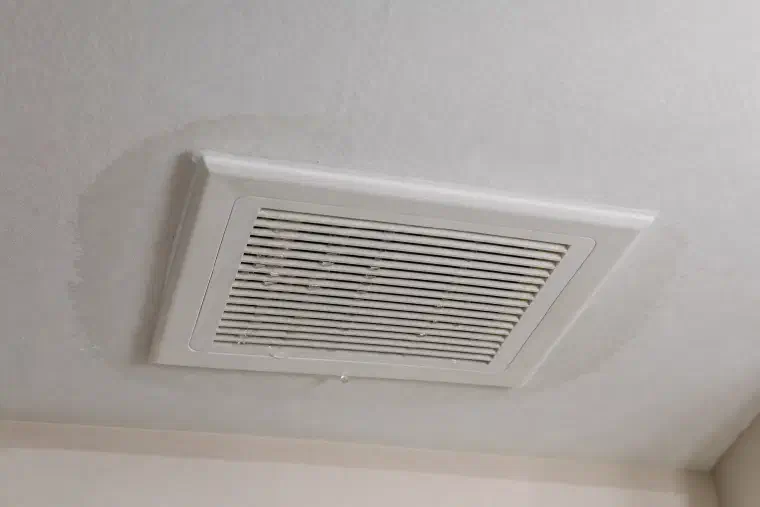
Most of the time, a bathroom exhaust fan leaking water is not a roof leak at all. Warm, wet air from your shower meets a cold duct in the attic, turns back into water, and runs down the pipe to the fan. Less often, rain is getting in around the vent cap on the roof. The two look the same from the bathroom, so it pays to tell them apart.
The short version
- If it drips after a hot shower, and not during rain, the cause is usually condensation inside the duct.
- If it drips during or after rain, the roof cap or its flashing is the more likely culprit.
- A fan that ends in the attic instead of outdoors is a problem on its own, whatever else is wrong.
- The fixes are cheap compared to what a wet attic does over a few winters.
- Rule out the roof first, then the duct, then how long the fan runs.
What makes a bathroom exhaust fan drip?
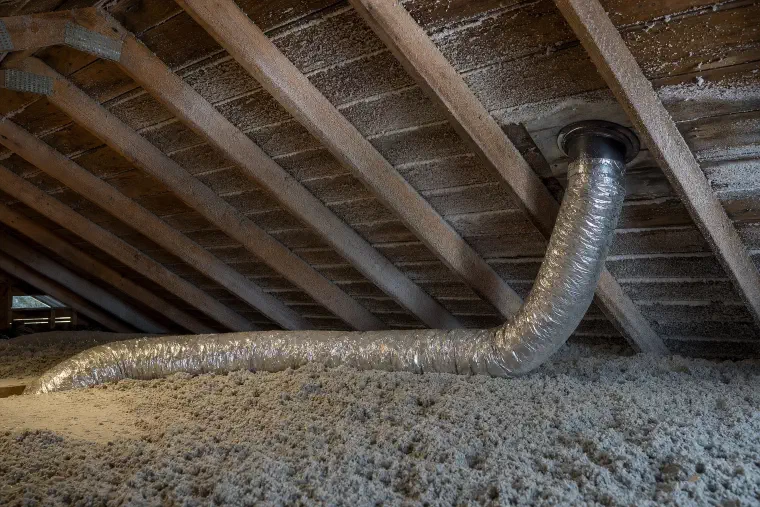
Condensation is the usual cause. A shower fills the room with warm, wet air, and the fan pushes it up a pipe through the attic. When that pipe is cold, the air cools, can no longer hold the water, and drops it on the inside of the pipe.
The water has to go somewhere. If the duct sags, it collects in the low spot and then runs back toward the fan, because the fan housing is the next low point. That is the drip you see in the bathroom. The Department of Energy’s Building America Solution Center says to insulate the duct (opens in a new tab) to minimize condensation, and to let it slope down and away from the housing so condensation drains away from the fan.
How do you tell condensation from a roof leak?
Watch when it drips. Condensation shows up after a hot shower, or on cold mornings, and it stops when the weather dries out. A roof leak follows the rain.
| What you notice | Likely cause |
|---|---|
| Drips after a shower, worse in winter | Condensation in the duct |
| Drips during or right after rain | Leak at the roof cap or its flashing |
| Drips on cold mornings, dry in the afternoon | Frost melting inside the duct or on the cap |
| Brown stain around the grille that keeps spreading | Slow, repeated wetting, from either cause |
| Water only in a heavy, wind-driven storm | Cap or flashing failing in one wind direction |
One thing to keep in mind: the two can happen at the same house. A fan can sweat in January and leak in a thunderstorm. Fix one and the other can still be there.
Why does the duct get so cold in the attic?
Because it is a thin pipe in an unheated space. In a Maryland winter the attic air is close to the outside air, and a bare metal or foil duct matches it quickly. The warmer and wetter the air inside, the more water it drops.
This Old House says insulated ducts help prevent condensation in cold attics (opens in a new tab), and recommends a minimum R-value of 6. R-value is just how well insulation resists heat. Higher is better. The same guide says every joint and connection has to be sealed before the duct is insulated, and that the insulation should not be squashed and should reach all the way to the roof vent.
Thin “insulated” flex duct from a hardware store often does not meet that. Smooth rigid duct is preferred over flex, and if flex is used it should be stretched tight to avoid sagging (opens in a new tab). A droopy flex duct is a water trap.
Can the roof cap cause the leak?
Yes, and it is the part we handle. Every bath fan that ends on the roof has a cap, a short pipe and flashing, which is the metal collar that sheds water around the base. Those parts wear out like any other pipe through the roof.
We see cheap rubber collars crack in 3 to 5 years, and any seal that depends on caulk is on a clock of about 5 to 10 years. A cracked collar lets rain run down the outside of the pipe and into the attic, and from there it can reach the fan housing. This Old House lists the usual fixes for moisture around a roof vent: reapply sealant and make sure the flashing is right (opens in a new tab). On an older roof, we would rather replace a worn cap than keep re-sealing it.
Roof exits also make condensation worse, because the duct has to climb into the coldest part of the attic and the water tends to run back down it. A wall exit is often easier to keep dry. Our article on dryer vents through the roof covers the same trade-offs.
Is your fan venting into the attic?
Check, because it changes everything. Fans are supposed to vent outdoors. Tom Silva of This Old House says they have to be vented outside the house, not into the attic (opens in a new tab), where the moisture lands on the underside of the roof.
A duct that has come off its fitting, or a short stub that just stops in the insulation, does the same thing. The damp air condenses on the cold roof boards in winter. The boards soak it up and dry out dozens of times a season, and that can ruin the decking without a drop of rain coming through from above. We find bath fans and dryers ending in the attic during ventilation work, and it often leads to mold and new decking. Decking is priced per 4 by 8 sheet and typically runs $70 to $150 installed. Our piece on what causes mold in the attic shows what to look for.
How do you stop a bathroom fan from dripping?
Work from the roof inward, one cause at a time. Here is the order we would go in.
- Look at the roof cap from the ground, or have us do it. A cracked collar, a loose cap or a missing screen is a quick fix.
- Look at the duct on a cold morning. Frost on the pipe or the roof boards means the air is condensing.
- Insulate and seal it. Seal the joints, wrap the whole run, and keep it from sagging.
- Make sure it slopes toward the outside, so water drains out rather than back to the fan.
- Check the damper. The wall cap should include a damper that closes when the fan is not exhausting (opens in a new tab), which keeps cold air from sitting in the duct.
- Run the fan longer. The same federal source recommends leaving it running for one hour after a shower (opens in a new tab). A timer switch does this for you.
Duct work in the attic is a handyman or HVAC job, and most people can do the insulating themselves if the attic is easy to reach. The roof side is ours. Winter is the best time to inspect an attic, because frost on the underside of the boards shows moisture problems that are invisible the rest of the year.
Common questions
Is a dripping bathroom fan dangerous?
The water itself is not, but the damage it leaves can be. Repeated wetting stains the ceiling, soaks the insulation and can grow mold. Fix it before the stain turns into soft drywall.
Why does my fan only drip in winter?
Cold is what turns the warm air back into water. The bigger the gap between the damp air in the duct and the cold air around it, the more water you get. That is why winter mornings are the worst.
Will a bigger fan help?
Not by itself. A stronger fan moves the damp air out faster, which helps, but a bare duct in a cold attic still sweats. Insulation and slope do more.
Should I just caulk around the vent?
Only if the caulk is sitting on sound flashing. Caulk is a consumable, and a vent that relies on it will leak again. A worn cap or collar should be replaced.
What to do next
If the drip follows the rain, or the cap on the roof is cracked, loose or missing, the roof side is our job. Our attic venting repairs page covers leaking vents and how we reseal them into the roof. Our free roof inspection looks into the attic when we can reach it safely, and we will tell you what we see. Call us any time, day or night.


