

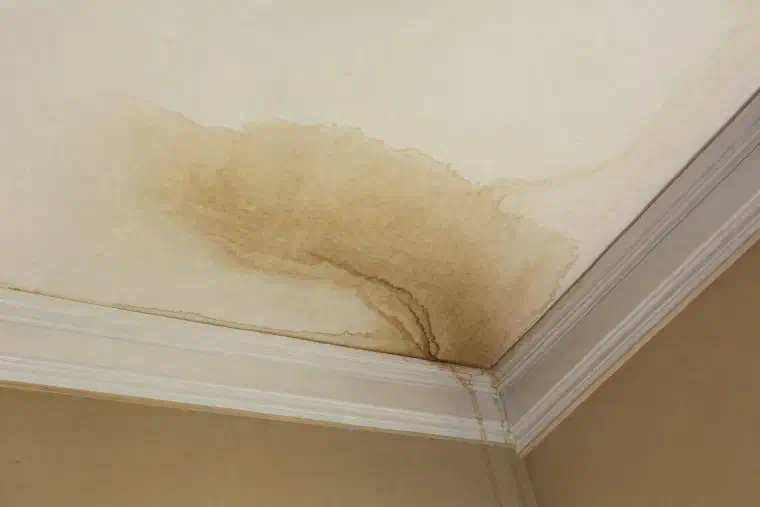
A chimney leaking after rain is usually a flashing problem, not a brick problem. Flashing is the strip of metal that seals the joint where the chimney meets your roof, and when it fails, water runs in along the brick. Cracked crowns and crumbling mortar cause the rest.
The short version
- Most chimney leaks start at the flashing, the metal where the chimney meets the roof.
- Caulk is a common culprit. It is a stopgap that tends to give out in 5 to 10 years.
- A cracked crown (the concrete cap) or crumbling mortar can let water in higher up.
- The stain on your ceiling may sit well away from the chimney, because water travels.
- A reflash typically runs $800 to $2,200. Brick repair is a separate bill.
Why does a chimney leak at the roof line?
The roof line is where shingles stop and brick starts, and that joint is the weak spot. Shingles shed water on their own. A brick column poking through the roof does not, so metal flashing has to bridge the gap. One roofer writing for This Old House says his firm gets more calls about chimney leaks (opens in a new tab) than about any other problem.
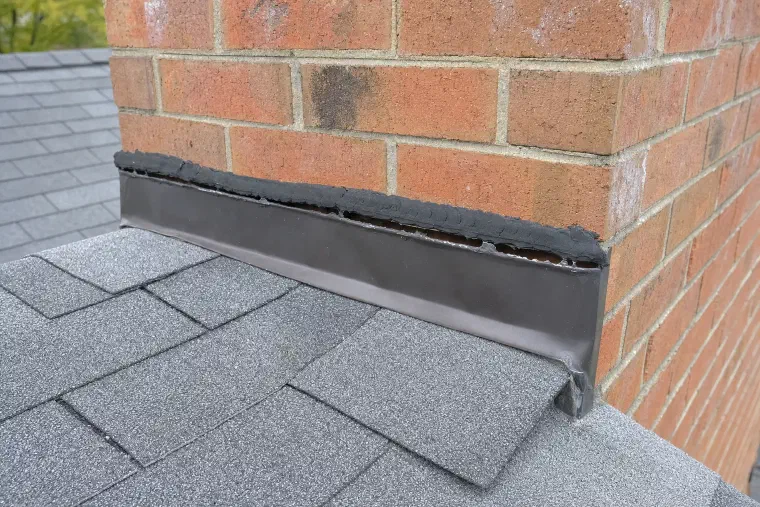
A proper job uses two layers. Step flashing (opens in a new tab) is a set of L-shaped metal pieces woven into the shingles and lapped up the side of the chimney. Over it goes a second layer, called counterflashing, which is set into the mortar joints and folded down over the first.
When either layer rusts, lifts or was never set right, rain finds the gap. That is the answer to most “why is my chimney leaking” calls.
Is caulk the reason my chimney is leaking?
Often, yes. Plenty of chimneys have flashing that was simply caulked to the brick, with no metal cut into the mortar above it. It looks tidy and holds for a few seasons.
We say it plainly: caulk is a consumable, and any flashing that depends on it is a scheduled leak. Sealant tends to last 5 to 10 years. This Old House makes the same point about the corners, noting that caulk can work itself loose (opens in a new tab) and is not a substitute for properly overlapped flashing.
A fresh bead of caulk over the old one is also the most common bad repair we see. Roofing tar and caulk trap moisture and can hide rotted decking underneath. The leak stops for a winter, then comes back.
Could the chimney crown be the problem?
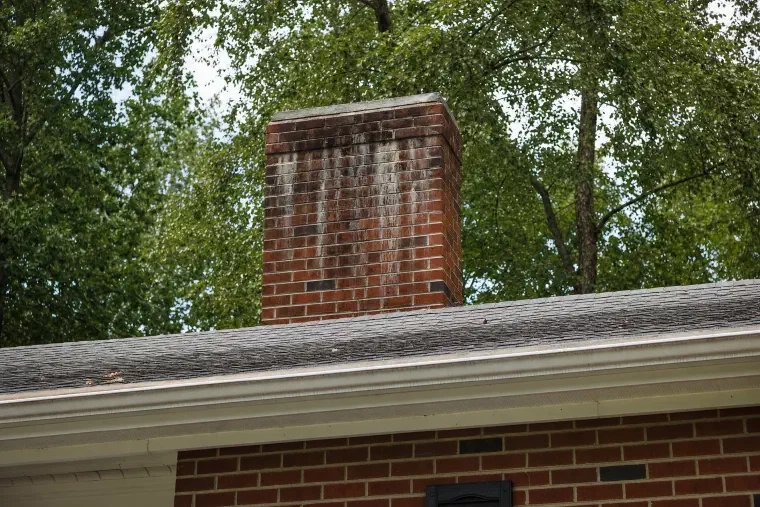
Yes. The crown is the slab of concrete across the top of the chimney, around the flue pipe. When it cracks, rain gets into the brick from above and runs down inside it, long before it reaches the roof.
If your stain is worst after a long soaking rain, or you see white streaks or damp patches on the brick, look up. We cover the details in what a chimney crown is and why it cracks.
What about the bricks and mortar?
Old mortar breaks down, and then the brick itself soaks up water. The National Park Service notes that when mortar and brick pull apart, water can penetrate the hairline cracks (opens in a new tab) that form. Freeze and thaw does the rest, which matters in Ellicott City winters.
This also affects the roofer’s job. Flashing has to be set into sound mortar. If the mortar is crumbling, it has to be repaired first, and masonry work cannot be done below 40°F. That is why a winter leak sometimes waits for spring.
What are the usual causes, side by side?
| Cause | What you may notice | What a fix typically runs |
|---|---|---|
| Failed or caulked flashing | Stain near the chimney after rain, rust or a cracked bead at the roof line | $800 to $2,200 for a reflash |
| Cracked crown | Stain after long rains, cracks or white streaks up top | Separate masonry work |
| Crumbling mortar or brick | Damp patches on the brick, loose mortar | $800 to $6,000 by a masonry sub |
| Chimney needs a rebuild | Brick that cannot hold new flashing | $3,500 to $8,000 for a rebuild and reflash |
These are typical ranges for our area, not a price list. Your roof sets the real number. For a longer breakdown, see what chimney flashing repair costs.
Why is the stain nowhere near my chimney?
Because water does not drip straight down. It runs along the roof deck and the rafters before it shows up on a ceiling. This Old House advises that the leak likely starts higher up (opens in a new tab), so you trace any sign of water uphill.
The stain is also the last stage, not the first. Water has usually been getting in for a while, wetting the decking and insulation before anything shows inside. If it only leaks in hard, windy rain, that often points to flashing that fails when rain blows sideways.
Not every leak near a chimney is the chimney. Condensation, a vent, a window or siding can leave a similar mark, which is why a proper look matters before anyone pays for a repair. Our guide to finding a leak in your roof walks through it.
Common questions
Can I just put more caulk on it?
You can, and it may hold through a few storms. But it covers a problem without fixing it, and it makes the real repair harder later. If you must do something before a roofer arrives, a tarp is a better stopgap than another bead.
How do I know it is the flashing and not the crown?
Look at where the water shows. A stain that follows rain only at the roof line points to flashing. Damp or streaked brick high on the chimney points to the crown or mortar. A roofer can often tell from the roof, and the attic tells the rest.
Will a repair stop the leak for good?
We cannot promise that. Leak tracing is a bit of detective work, and a second visit is sometimes needed. A repair typically comes with a warranty on the repaired area of 30 days to 1 year, and a new leak elsewhere is a new call.
Does the stain need fixing too?
Yes, separately. Drywall, paint and insulation are never part of a roof repair. Plan for those as their own job, after the roof is dry.
What to do next
If water is coming in near your chimney, have the flashing looked at before the next freeze. Our free roof inspection covers the flashing, and there is no obligation to book work. When you know what the chimney needs, our chimney flashing repair page explains how we do it.


