

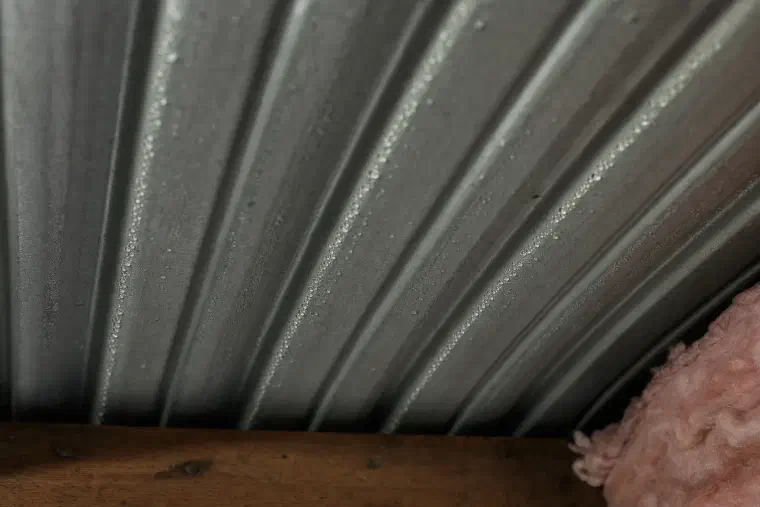
A metal roof usually leaks at a small gap, not through the metal itself. The usual spots are a screw washer, a seam, a flashing or a pipe boot. Sometimes it is not a leak at all, because water can form on the underside of the metal and drip. When and where it drips tells you which one you have.
The short version
- The panels are rarely the problem. The holes and joints in them are.
- Exposed screws, seams, and the metal around pipes, vents and chimneys cause most leaks.
- A drip on a dry day may be condensation, not a leak.
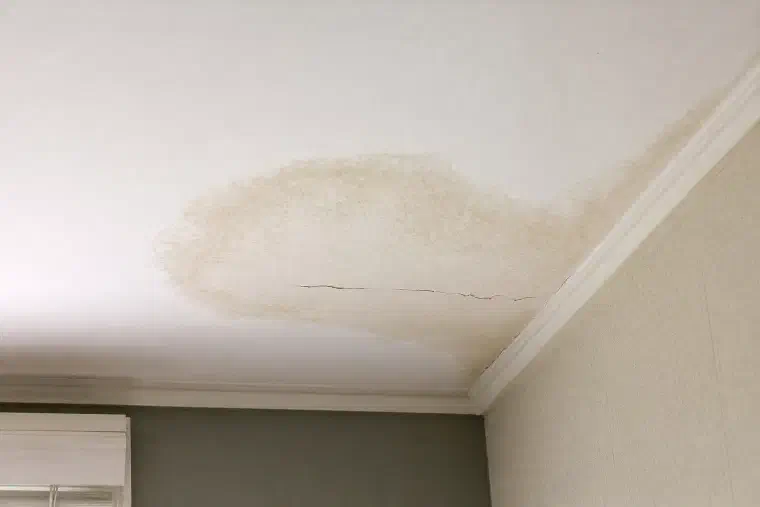
- A stain on the ceiling shows up late, so water has often been getting in for a while.
- A leak is found by tracing it, not by sealing the first thing you see.
Is it a leak, or is it condensation?
It can be either, and the weather on the day it drips is the best clue. Water gets in from outside when it rains. Condensation forms on the underside of the metal when warm, damp air inside meets a cold panel. The Building America Solution Center warns that condensation can occur on the underside of the metal roofing (opens in a new tab), and says the roof needs good venting to deal with it.
Here is the test. If it only drips during or right after rain, water is coming in. If it drips on a dry, cold morning with no rain in sight, think condensation. The cause there is usually damp air from the house, such as a bath fan or dryer that ends in the attic, and not the roof at all. Fixing a roof that was never leaking is an expensive way to learn that.
Which part of a metal roof leaks first?
On a roof with visible screw heads, the screws leak first. Each one is a small hole, and the only thing sealing it is a rubber washer. The Building America Solution Center says don’t underdrive or overdrive the fasteners (opens in a new tab), and that is a fault that starts on day one. Rubber also ages in the sun and heat, and the panel moves a little with every temperature swing, which is how a screw ends up lifting.
Hidden-fastener roofs, like standing seam, have no screw heads out in the rain. Their leaks tend to come from the parts that are exposed. We cover the screw side in more detail in why metal roof screws leak.
Can seams and edges leak?
Yes. Where one panel overlaps the next, and along the ridge and the edges, water depends on a lap, a sealant strip or a piece of trim. These joints need room to move. The Insurance Institute for Business & Home Safety says ridge flashing requires expansion joints (opens in a new tab) to prevent leaking around the screws, which tells you how much the metal shifts through the year.
Leaves and dirt that pile up against a seam hold water against it. It also leaks more in wind-driven rain, when water is pushed sideways up under a lap that sheds ordinary rain without trouble.
Why do pipes, vents and chimneys leak?
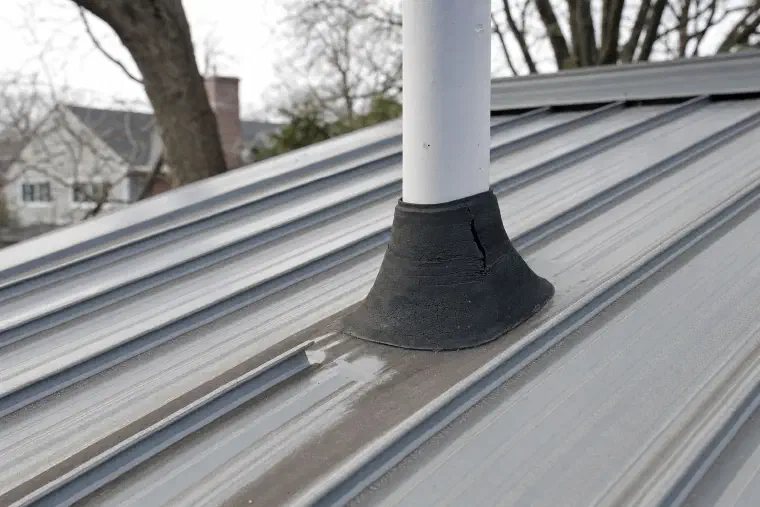
Because the metal has to be cut and flashed around anything that comes through it, and that joint is the weak spot. IBHS says penetrations that cut through the seam of the panel are a potential source (opens in a new tab) of water infiltration, and that they should be kept to a minimum.
The rubber collar around a plumbing vent, called a pipe boot, is the most common failure. Rubber cracks, and a boot that looks fine from the yard can be split on the far side. A cracked boot is usually one of the cheaper fixes, and we walk through it in what a pipe boot is. Chimneys and skylights use flashing instead of a boot, and the same rule holds. Anything held in place by a bead of caulk is on a clock. We see caulk last 5 to 10 years, and then it lets go.
What does a past repair have to do with it?
Often more than you would think. A common story is that a roof leaked once, somebody smeared roofing tar or a tube of caulk over the spot, and the leak moved or came back. Tar keeps new material from bonding, can trap moisture, and hides the real source. IBHS also notes that silicone may not be compatible (opens in a new tab) with the sealant already on a metal panel roof, so the wrong product on top of the old one can peel away or fail again.
If a patch is already up there, tell whoever looks at the roof. It changes what they need to remove first.
Where is it dripping, and what does that point to?
This table pairs what you notice with the most likely cause and what gets checked first.
| What you notice | A likely cause | What gets checked |
|---|---|---|
| Drips only in heavy or windy rain | A lap, seam or screw near the edge | Screws and overlaps along the wet line |
| Stain near a pipe or vent | A cracked boot or worn seal | The rubber collar and the seal around it |
| Drips on a dry, cold morning | Condensation under the panel | Bath fan and dryer vents, attic air |
| Stain beside a chimney or wall | Flashing or its sealant | The metal and caulk where roof meets wall |
| A wet spot that moves around | Water running along a panel or beam before it drops | The roof above and uphill of the stain |
That last row matters. Water runs downhill along a panel or a beam before it drops, so the stain is often a few feet from the hole. Our guide on how to find a leak in your roof shows how to trace one safely.
What can you check yourself?
Stay on the ground and in the attic. Do not walk on a metal roof, especially a wet or frosty one, because the panels are slick. From the yard, look for a panel that has lifted, a missing screw, a pipe boot with a visible split, or a pile of leaves in a valley. Indoors, look in the attic on a rainy day for damp wood, wet insulation or a drip you can follow back up.
This Old House says roofing experts recommend inspecting your roof at least once per year (opens in a new tab), and IBHS adds that roof penetrations and skylights may need to be annually inspected and resealed (opens in a new tab). A yearly look is cheaper than a ceiling.
What does it cost to fix?
It depends on what is wrong, and most of the cost is the visit, not the part. Around Ellicott City, a single leak diagnosis and repair typically runs $500 to $1,600, and a pipe boot typically runs $350 to $750. Finding the exact entry point, when it takes a hose test or moisture meter, is a separate service that typically runs $150 to $400. Those are area ranges, not a quote.
We will not promise a repair stops the leak the first time. Leak diagnosis is a matter of probability, and a second visit is sometimes needed. Interior repairs, like drywall and paint, are never part of a roof repair.
Common questions
Should I put sealant on the screws myself?
Not as a first move. Fresh sealant over a screw that is backing out only hides the problem for a season. The screw usually needs to be reset or replaced, and the washer swapped, so the sealant is not the thing doing the work.
Is it covered by a metal roof warranty?
Maybe, but read the paperwork. Check what it covers: the metal’s finish, the panels, or the installation. A leak at a screw, boot or flashing is an installation question, so ask who stands behind the labor and for how long.
Can a metal roof leak if it is new?
Yes. A new metal roof can leak from a screw driven too tight or too loose, a lap left unsealed, or flashing that was never fully closed up. That is why a roof is worth checking after the first few big storms.
What to do next
If water is coming in now, put a bucket under it and call us any time, day or night. If it is a slow stain, a free roof inspection gets someone on the roof to find the real source and tell you plainly if it is a small repair or something bigger. And if you are still deciding on a roof, our metal roofing installation page explains what we put in and what it covers.


