

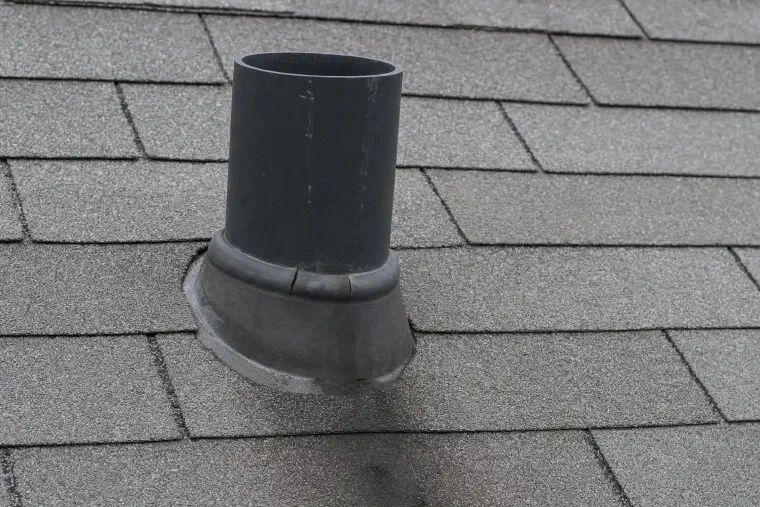
A roof vent usually leaks because the seal around it has worn out, not because the vent itself is broken. On a pipe vent that seal is a rubber collar. On a box vent or a ridge vent it is the flashing, the sealant or the nails around the edge. The fix is usually small, as long as you catch it before the wood underneath goes soft.
The short version
- Most leaking vents are pipe vents with a cracked rubber collar.
- Box vents and ridge vents leak at their edges, where flashing, nails and sealant do the work.
- Sometimes it is not a leak at all. Moist indoor air can drip like one.
- A pipe boot swap typically runs $350 to $750. A ridge vent repair typically runs $700 to $1,600.
- Caulk is a short-term patch. It does not repair a split collar.
Which kind of roof vent is leaking?
Start by working out which vent it is, because each kind fails in a different way. Most roofs have a mix. There are round plumbing pipes, square or domed box vents, and sometimes a long ridge vent along the peak. Our guide to the different types of roof vents shows what each one looks like.
| Vent | Where it is | Where it usually leaks |
|---|---|---|
| Plumbing pipe vent | A round pipe through the slope | The rubber collar around the pipe |
| Box vent | A small square or domed cap on the slope | The edges of its metal base, or exposed nail heads |
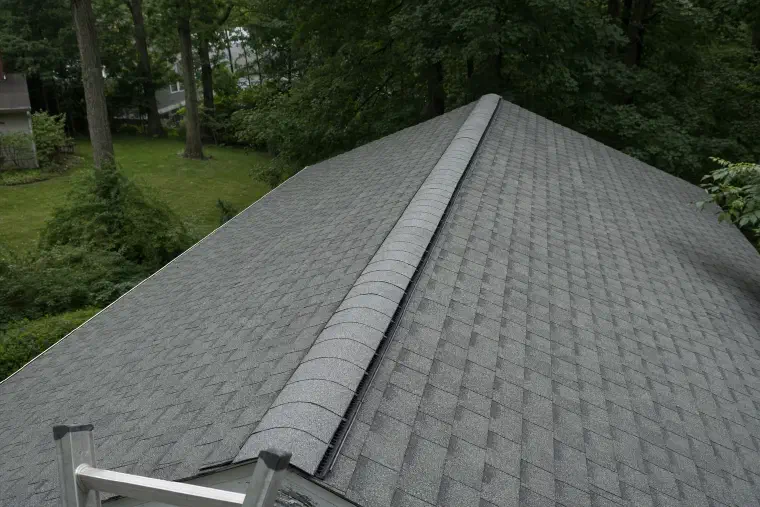
| Ridge vent | A long strip along the peak | The seal at the ends, or a bad cut or nailing job |
| Bath fan or dryer vent | A cap with a duct underneath | The cap flashing, or moisture inside the duct |
Why does a pipe vent leak?
The rubber collar breaks down in the sun and cracks. This Old House lists deterioration of the rubber boot or flashing (opens in a new tab) around the pipe and extended exposure to UV rays among the main causes. It also notes that an installer who leaves a sharp pipe edge can slice or weaken the seal (opens in a new tab) from the start.
We see cheap rubber collars crack in 3 to 5 years. Rubber that is split on top can look fine from the yard, so the leak seems to come and go with the wind. Our page on what a pipe boot is goes into the details.
Why does a box vent or a ridge vent leak?
Because they are held on with flashing, nails and sealant, and each of those can fail. A box vent sits over a hole in the roof. Its metal base has to tuck under the shingles above it and lie over the shingles below it. If the base is set wrong, or a nail head is left uncovered, water finds the gap.
A ridge vent has a different weak point. This Old House says ridge vents have baffles that block rain, snow, and debris (opens in a new tab), and also says plainly that no ridge vent is completely weatherproof (opens in a new tab). It adds that improper installation can reduce airflow or lead to leaks (opens in a new tab). A hard, sideways rain is the usual time one shows itself. For more on how they are built, see what a ridge vent is.
Caulk comes into it too. Any vent detail that depends on sealant has a life of about 5 to 10 years, and we call that a scheduled leak. When the bead dries out and pulls away, the leak is already on its schedule.
Is it a leak, or is it condensation?
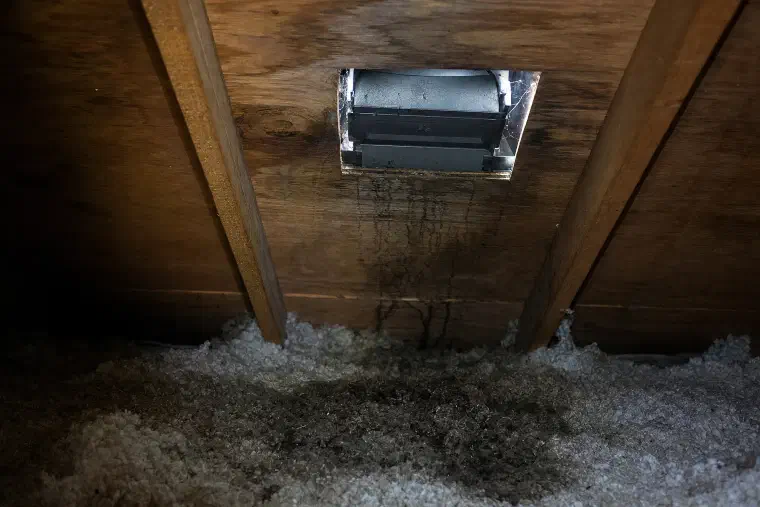
Sometimes the roof is fine and the water comes from inside the house. This Old House reminds readers that not all water damage in the attic comes from a roof leak (opens in a new tab), and that condensation can cause damp walls, musty smells and buckled ceiling materials.
The usual culprits are a bath fan or dryer vent that ends in the attic instead of outside, and warm indoor air rising through gaps in the ceiling. Water that shows up on a cold morning with no rain the night before points that way. Frost on the underside of the roof boards in winter is the other tell, and winter is the best time to look.
If the vent is an exhaust vent, the fix is in the duct, not on the roof. A roofer can show you where the duct ends.
How can you tell which vent is the problem?
Look for the stain, then follow the water uphill. A stain on the ceiling is almost never right under the hole. This Old House lists damp or moldy attic insulation (opens in a new tab), dripping sounds in the attic during rain, visible cracks or gaps around the pipe, and stains on the ceiling or walls near the pipe as the signs.
Here is a quick check you can do without climbing:
- Walk the outside of the house with binoculars. Look at every vent for a gray, dry, split or gapped collar, a loose cap or a lifted shingle beside it.
- Go into the attic with a flashlight on a dry day. Look under each vent for dark trails on the wood.
- Press a gloved finger into the insulation below. If it is cold and wet, the water has been coming in for a while.
Our guide to finding a leak in your roof walks through the whole attic search.
What does fixing a leaking roof vent cost?
A pipe boot typically runs $350 to $750, and most small repairs land near the minimum service call because the crew’s time and the trip cost more than the part. A ridge vent repair typically runs $700 to $1,600. Finding a leak that is hard to trace can cost extra: active leak diagnosis typically runs $150 to $400, and it is sometimes credited toward the repair.
These are typical ranges for the Ellicott City area, not a quote. Wet decking found under the old vent typically adds $150 to $500+, and ceiling paint and drywall are never part of a roof repair. A repair on site usually takes 1 to 4 hours.
Common questions
Can I caulk around a leaking roof vent?
You can, and it will probably hold for a season or two. It is a patch. If the rubber has split or the metal base is loose, the caulk covers the symptom and the leak comes back. This Old House itself says to reapply caulk every few years (opens in a new tab).
Why does my roof vent only leak in heavy rain?
Because the water is getting in at a gap that only opens up when rain blows in sideways or runs hard down the slope. It still counts as a real leak. A vent that drips only in a storm has been wetting the wood under the shingles for some time before anything shows in a room.
How long does a roof vent last?
The vent body often outlasts the seal around it. A rubber pipe collar is usually the first part to go, long before the shingles do. A swap is a small job and it does not mean the roof is finished.
Does a free inspection check the vents?
Yes. Our free roof inspection includes a walk on the roof and a look at the flashing and the things that come through it. There is no obligation to book work.
What to do next
If a vent is dripping, put a bucket under it, keep an eye on the stain, and have the vent looked at on the next dry day. We fix leaking vents as part of roof repair, and the phone is answered 24/7 if water is coming in now.


